
Art Deco 795mm Products
Showing 1 to 20 of 28 products
Frequently Asked Questions
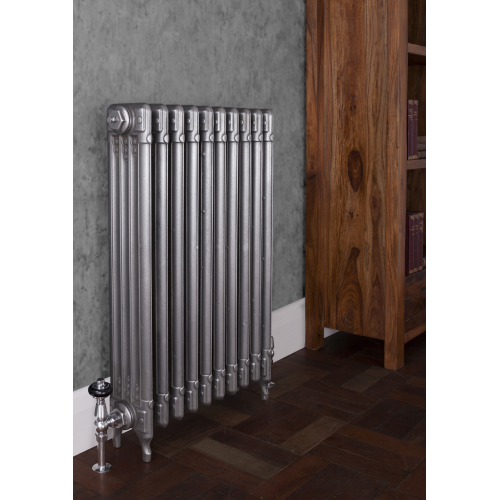
How does the 795mm height of this Art Deco model influence the convection currents within a room compared to the shorter 585mm version?
The 795mm height creates a taller vertical channel for air to pass through. This technical difference enhances the chimney effect, where cold air is drawn in at the bottom and accelerates upwards as it heats, projecting warm air further into the room. This makes the 795mm model significantly more effective at heating rooms with higher ceilings or larger air volumes where creating a strong convection cycle is necessary to eliminate cold spots.
What is the exact heat output per section for the Art Deco 795mm radiator and how do I calculate the total radiator size needed?
Each individual section of the Art Deco 795mm radiator generates approximately 462 BTUs (136 Watts) at Delta T50. To solve the sizing problem for your specific room, you must divide your total heat loss requirement by 462. For example, a large room requiring 6500 BTUs would technically require a 14 or 15 section radiator. This modular output allows you to size the radiator precisely to the heat load, preventing the inefficiency of undersized heating.
Why is the structural integrity of the floor critical when installing the Art Deco 795mm radiator?
The Art Deco 795mm is an extremely heavy unit due to its increased height and cast iron density. A single section weighs approximately 12.2 kg. A typical 10-section assembly weighs over 120 kg empty, and significantly more when filled with water. Technically, you must ensure that your floor joists or concrete subfloor can support this concentrated point load. If installing on suspended timber floors, placing the feet directly over joists or adding noggins for reinforcement is a mandatory safety step to prevent floor bowing.
Does the 140mm depth of the Art Deco 795mm radiator create an obstruction issue in narrow hallways?
Yes, the 140mm section depth is substantial. When combined with the necessary wall stay clearance of approx 20-30mm, the total projection from the wall will be around 160mm to 170mm. In narrow Victorian hallways or landings, this can restrict the walkway. You must measure the clear passage width technically to ensure that installing this deep radiator does not violate building regulations regarding escape route widths or cause an obstruction to door swings.
What specific assembly tool is required if the Art Deco 795mm radiator is supplied in two parts due to weight restrictions?
For safety and handling, radiators longer than 10-12 sections may be delivered in smaller banks. To join them on-site, you need a Cast Iron Radiator Joining Key and a set of Joining Nipples. The joining key passes through the centre of the radiator to engage the internal thread of the nipple. You must apply significant torque to pull the heavy 795mm high sections together, compressing the gasket to form a permanent, watertight seal.
Why is a luxury wall stay technically recommended for the 795mm high Art Deco radiator?
While the radiator stands on its own feet, the 795mm height makes it top-heavy with a high centre of gravity. A Luxury Wall Stay is a rigid brass or chrome arm that clamps between the radiator sections and anchors it to the wall. Unlike a simple strap, a luxury stay provides a solid mechanical brace that prevents the heavy radiator from tipping forward if accidentally impacted, which is a critical safety requirement for such a tall, heavy object.
Can I use standard aggressive plumbing flux when installing the copper pipework to the Art Deco 795mm radiator?
No, you should be extremely careful with acidic plumbing flux. If excess flux enters the radiator during installation, it can sit in the bottom of the cast iron sections and cause rapid internal corrosion or pinhole leaks. Technically, you should flush the pipework thoroughly before connecting the valves to the radiator to remove any flux residues, solder blobs, or copper swarf. This ensures the neutral pH of the system water is maintained to protect the cast iron.
What specific type of wall stay is required for the Art Deco 585mm radiator and why is it necessary?
Cast iron radiators are floor-standing due to their weight, but they are top-heavy and can be unstable. A Wall Stay (or retaining bracket) is technically mandatory to anchor the top of the radiator to the wall, preventing it from tipping forward if knocked. The Art Deco 585mm requires a "Luxury" or "Standard" wall stay that clamps between the sections. The wall stay does not bear the weight (the feet do that), but it provides essential lateral stability for safety.
What is the advantage of the factory applied Carron Metallic finish over the standard Grey Primer?
The standard Grey Primer is a temporary transit coating that is porous and not rust-proof. If left unpainted in a damp room, it will eventually rust. The Carron Metallic finish is a professional, high-grade topcoat applied at the foundry. It creates a sealed, non-porous barrier that is technically resistant to moisture and oxidation. It solves the problem of trying to paint complex cast iron shapes by hand and ensures the radiator is ready to withstand bathroom humidity immediately upon installation.
How does the thermal mass of the Art Deco 795mm radiator affect the control strategy for my central heating system?
The Art Deco 795mm has a very high thermal mass, meaning it takes longer to heat up but holds heat for hours after the boiler turns off. Technically, this means it is not suitable for "on-demand" rapid heating strategies. You should solve this by programming your thermostat to turn on 30-60 minutes earlier than required. Conversely, you can turn the heating off earlier in the evening, as the cast iron will continue to emit useful radiant heat for a long period, improving comfort efficiency.
Why is it critical to flush the system before installing the Art Deco 585mm radiator on an existing heating circuit?
Cast iron radiators can contain small amounts of manufacturing residue (casting sand or metal dust) inside. Technically, you must thoroughly flush the radiator and the entire heating system before final commissioning. Failure to do so can lead to sludge build-up in the boiler or pump, reducing efficiency and potentially causing damage. A "power flush" or a comprehensive chemical flush is highly recommended when retrofitting cast iron radiators to an old system.
Are the 1/2 inch BSP connections on the Art Deco 795mm radiator compatible with modern thermostatic valves?
Yes, the radiator features standard 1/2 inch BSP female tappings at the bottom corners. This makes it fully compatible with all modern Thermostatic Radiator Valves (TRVs). However, for a 795mm high radiator, the valve choice is aesthetic as well as functional. You should choose a "traditional" style TRV (often brass or black nickel) that matches the period look, ensuring the valve body is heavy-duty enough to visually balance the large scale of the radiator sections.