
Kitchen Heating Hacks: Where to Put a Radiator When You Have No Wall Space
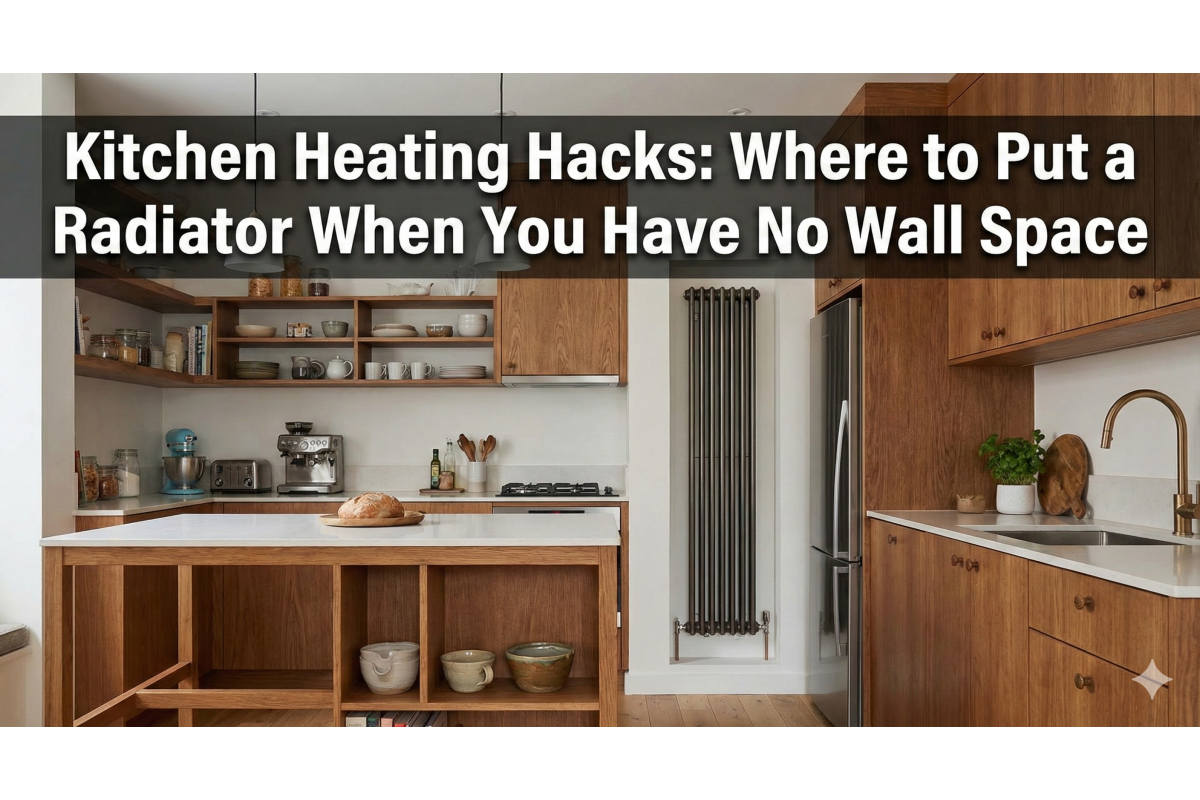
In the landscape of British interior design, a quiet revolution has taken place over the last two decades. We have systematically dismantled the cellular architecture of the Victorian and Edwardian eras, tearing down partition walls and bricking up fireplaces in a relentless pursuit of light, air, and "flow." The open-plan kitchen-diner has become the undisputed heart of the modern home a multi-functional cathedral of culinary activity, social interaction, and family life. We have replaced masonry with glass, installing expansive bi-fold doors that blur the boundary between the indoors and the garden, and swapped cramped galleys for sprawling islands that maximize every cubic inch of storage. However, this architectural liberation has birthed a significant, often overlooked engineering crisis: the thermal paradox.
By removing the walls, we have removed the very structures designed to host our heating emitters. We have increased the volume of air requiring heat while simultaneously reducing the available surface area to mount the radiators needed to warm it. The result is a phenomenon well-known to heating consultants and unhappy homeowners alike the "Icebox Kitchen." It is a space that looks spectacular in an Instagram feed but feels like a walk-in refrigerator on a damp November morning. The frustration is palpable as you stand in your dream kitchen, surrounded by quartz worktops and high-end appliances, shivering because the only heating source is a toaster and the residual warmth of last night’s dinner.
The solution requires a fundamental shift in mindset. We must stop looking for wide, horizontal spaces because in a modern extension, they simply don't exist anymore. We must start thinking vertically, utilizing the "dead zones" of architecture: the structural pillars, the cabinet end-panels, and the narrow reveals. To achieve this, we must embrace a heating emitter designed specifically for versatility and high output in small footprints: the column radiator. By leveraging the unique engineering properties of these multi-tubular units, we can solve the spatial puzzle without compromising on warmth or aesthetics.
Why Your Kitchen is Cold
The Disappearing Wall Phenomenon
To understand the solution, we must first deeply analyze the problem. The United Kingdom is experiencing a "spatial contraction" in new builds and a "spatial reconfiguration" in older stock. Data indicates that the average square footage of living spaces is shrinking, forcing a radical rethink of how we utilize vertical planes. In a traditional 1930s semi-detached house, the kitchen was a small, functional room with four solid walls. A single Type 22 panel radiator under the window was sufficient.
Today, that same house likely has a rear extension. The dividing wall between the dining room and kitchen is gone. The rear wall is 80% glass. The side wall is lined with floor-to-ceiling "tower" units housing integrated fridges, ovens, and pantries. In this scenario, the wall space available for a radiator has dropped from perhaps 10 linear meters to near zero. Industry experts describe this as a game of "Tetris" where the radiator is the losing piece. It is often an afterthought, relegated to the smallest, coldest corner, or worse, undersized to fit a tiny gap. This is a fundamental error in thermal planning.
The "Cold Room" Syndrome
The "cold room" is a specific diagnostic category in heating consultation. It is characterized by a room that consistently fails to reach the set point of the thermostat or drops in temperature rapidly the moment the boiler cycles off. Kitchens are particularly susceptible due to "air changes." Extractor fans, opening back doors, and the natural stack effect of staircases draw warm air out of the kitchen at a rate far higher than a living room. Furthermore, the "sensible heat" generated by cooking is often overestimated. Homeowners assume the oven will heat the room. While a roast dinner might raise the ambient temperature by a few degrees for an hour, it does nothing for the Tuesday morning breakfast rush when the kitchen is a stagnant pool of cold air sitting on a tiled floor.
Thermodynamic Principles: Why Column Radiators Win
Radiant vs. Convective Heat
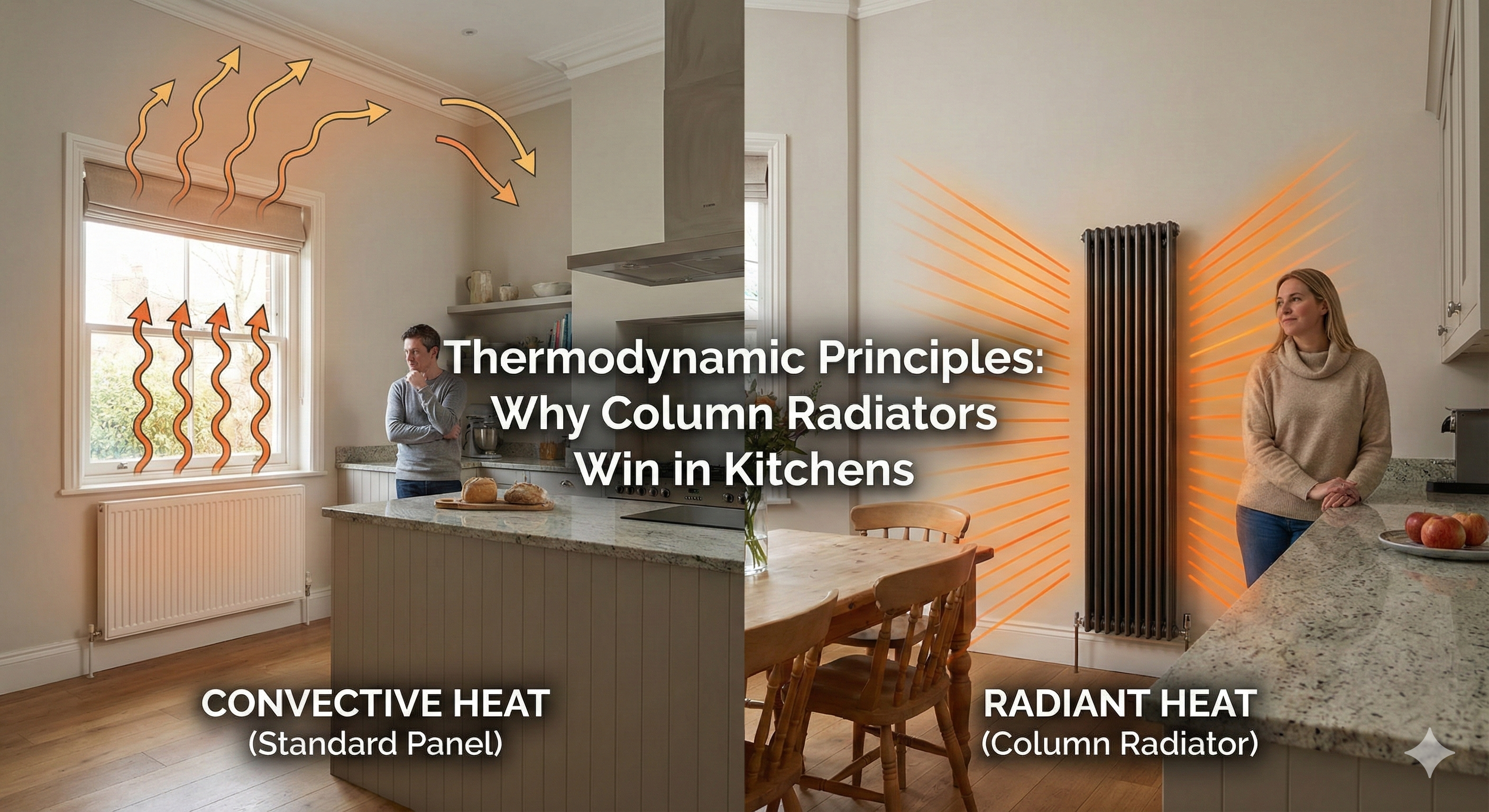
To choose the right radiator, one must understand the two primary mechanisms of heat transfer: radiation and convection. Standard panel radiators (Type 11/21/22) rely heavily on convection. They have fins hidden between the panels that heat the air directly. The hot air rises, hits the ceiling, cools, and falls, creating a loop. In a kitchen with high ceilings or an extractor fan running, convective heat can be easily sucked out before it warms the occupants.
Column radiators, particularly those made of steel or cast iron, are superior generators of radiant heat. This is the transfer of heat energy via infrared waves, traveling in straight lines from the source until they hit a solid object you, your granite worktop, or your dining table. For a kitchen, radiant heat is particularly valuable because it creates a feeling of comfort at lower air temperatures. When you are standing at an island chopping vegetables, a column radiator projecting radiant warmth directly at you feels significantly more comfortable than a fan heater blowing dry air around your ankles. [4, 2]
The Surface Area Multiplier
The genius of the column radiator lies in its geometry. A standard flat panel radiator has a front face and a back face. A column radiator acts like a concertina; it folds that surface area into a deep, three-dimensional structure. Consider a 3-Column Radiator from the Budget Radiators "Classic" range. For every inch of width, it has three tubes going back in depth (approx. 101mm deep). This means that a relatively narrow radiator can hold a significant volume of water and present a massive surface area to the air. By heating the air from multiple angles as it passes through the columns, these units can bring a room to temperature rapidly.
Strategic Placement Hacks – The "No Wall Space" Playbook
Now we move to the core actionable advice. Where exactly do you put a radiator when every wall is covered in cabinets or glass? Here are five battle-tested strategies used by heating engineers and interior designers.
Hack 1: The "Structural Pillar" Pivot
In almost every kitchen extension, there is a structural pillar. It’s the ghost of the old corner of the house, usually supporting a steel beam (RSJ). These pillars are often 400mm to 600mm wide too narrow for a cupboard, too obtrusive for a table. The strategy is to treat the pillar as a feature, not a bug. Mount a tall, narrow 2-Column Vertical Radiator on the face of the pillar. A radiator here radiates heat 360 degrees into the open space, rather than heating the back of a sofa. The Classic 2 Column (1800mm x 294mm) fits perfectly on a standard brick pillar, leaving space for valves on either side.
Hack 2: The Kitchen Island End-Panel
The kitchen island is the dominant feature of modern design. It is a massive block of joinery. The two short ends of the island are often "dead space" plain panels facing a wall or a walkway. The strategy here is to reinforce the end panel and mount a radiator directly onto the island. You cannot screw a 40kg radiator into a 18mm MDF panel, so during the kitchen installation, you must instruct the fitter to add internal timber bracing (noggins) behind the end panel to take the weight. Alternatively, use a floor-mounted radiator (with feet) so the island panel only provides stability, not load-bearing support. A short, chunky 3-Column or 4-Column radiator looks fantastic here, adding an industrial "engine room" vibe to the island.
Hack 3: The "Window Reveal" Low-Level Installation
Modern kitchens often have large windows with low sills (e.g., 400mm from the floor). Standard radiators are 600mm high and won't fit. The strategy is to go low and deep. Use a radiator that is only 300mm high but 3 or 4 columns deep. Cold air drops off the window glass; placing the radiator directly underneath catches this "downdraught," heats it, and circulates it into the room. If the wall under the window is weak or non-existent, use floor mounts so the radiator stands on its own legs. The Cornel Horizontal 3-Column (300mm high x 1374mm wide) fits under almost any window and outputs over 3000 BTUs. [8]
Hack 4: Behind the Door
There is almost always a door into the kitchen from the hall, the utility, or a pantry. When this door is open, it creates a triangular "dead zone" against the wall. Utilize this swing space with a slimline vertical radiator. Measure the distance from the wall to the open door face. A 2-Column radiator is roughly 65mm deep. Add 20mm for the bracket clearance. If your door stop is set to 100mm, the radiator fits perfectly behind the open door. Ensure you install a solid floor-mounted door stop to prevent the handle from slamming into the radiator fins.
Budget Radiators vs. The Market
As we analyze the landscape, it is crucial to compare specific offerings to understand value. The name "Budget Radiators" implies cheapness, but the analysis of their technical specs reveals a focus on "value engineering" rather than low quality. For instance, their steel column radiators use 1.5mm mild steel, which is comparable to premium brands. Thinner steel (1.0mm) found in cheap marketplace imports is prone to pinhole leaks. Furthermore, they test to BS EN 442 standards, ensuring the BTU outputs are accurate.
The Classic 2-Column Vertical: Compared to competitors like the Milano Windsor, the Budget Classic often comes in at a slightly lower price point for the same dimensions. A unique selling point is the availability of "Textured Anthracite" as a stock item. Many competitors only stock white and charge extra for colors with a 4-week wait. Budget Radiators stocks the anthracite, allowing for rapid deployment in renovations.
The Cornel Range: For those seeking "Industrial Chic," the Cornel is available in a "Bare Metal Lacquer." This finish shows the weld lines and manufacturing marks, sealed under a clear gloss. This is highly trendy in loft-style apartments and competes directly with premium raw metal ranges but often at a more accessible price point. The range of sizes in the Cornel line is exhaustive, including the hard-to-find 300mm high low-level options mentioned in our placement hacks.
Technical Installation Guide

Handling and Weight
A 1800mm vertical column radiator is heavy. A 10-section vertical radiator can weigh 30-40kg empty, and add another 10-15kg when full of water. You cannot hang this on plasterboard with standard rawl plugs. For solid walls, use heavy-duty expanding bolts (shield anchors). For stud walls, you must locate the timber studs. If the studs don't align with the bracket positions (which they rarely do), you must cut open the drywall and install a horizontal timber "patress" or noggin between the studs to screw into.
System Balancing
When you add a large vertical radiator to a kitchen, it often acts as a shortcut for the water because it has low resistance. The symptom is that the kitchen radiator gets scorching hot, but the upstairs radiators go lukewarm. The fix is balancing. You must partially close the "lockshield" valve (the one with the plastic cap) on the kitchen radiator. This restricts the flow, forcing water to travel to the rest of the house. This is critical for the efficiency of the whole system.
Regulatory Landscape and Safety Zones
Electrical Safety (BS 7671)
A common question is whether you can put a radiator next to a socket. While BS 7671 (The IET Wiring Regulations) does not explicitly ban sockets near radiators, industry guidance suggests a minimum separation of 150mm to 300mm. Heat can degrade the insulation on electrical cables over years, and you don't want to be reaching over a hot radiator to plug in a kettle. Furthermore, if a valve leaks, you don't want water spraying directly into a socket.
Appliance Clearances
The relationship between your radiator and your fridge is adversarial. Fridges work by pumping heat out; radiators pump heat in. Placing them side-by-side forces the fridge compressor to run continuously to fight the radiator's heat. Manufacturers typically mandate a 30cm (300mm) clearance between the appliance and a heat source. If space is tight, place a heat-insulating panel (like a decorative end panel with foil backing) between the radiator and the fridge to break the thermal bridge.
Conclusion: Reclaiming the Heart of the Home
The challenge of the "no wall space" kitchen is not a dead end; it is a design opportunity. By understanding the thermodynamics of your space and embracing the versatility of the column radiator, you can turn a freezing renovation into a cozy sanctuary. We have seen that the solution lies in verticality using the Classic 2-Column on pillars, the Cornel under low windows, and structural "hacks" like island mounting. Standard panel radiators simply cannot compete with the surface area and radiant comfort of a multi-column array in these complex environments.
Don't settle for a cold kitchen. Don't rely on your oven to keep you warm. Measure your pillars, check your clearances, and invest in a heating solution that is as robust and beautiful as the rest of your home. Warmth is not a luxury; it is the essential ingredient of a happy home.