
Clarendon 740m Products
Frequently Asked Questions
What are the specific structural floor load requirements for installing the heavy Clarendon 740mm radiator on a suspended timber floor
The Clarendon 740mm is a high mass radiator with each section weighing approximately 8.5 kg. A typical 10 section assembly weighs around 85 kg empty and over 100 kg when filled with water. Technically, you must verify that your subfloor can support this concentrated point load. If installing on suspended timber floorboards, it is critical to position the feet directly over the joists or install timber noggins (bracing) underneath the boards to distribute the weight and prevent the floor from bowing or sagging.
Why is the Clarendon 740mm technically described as a School House style radiator and how does this benefit maintenance
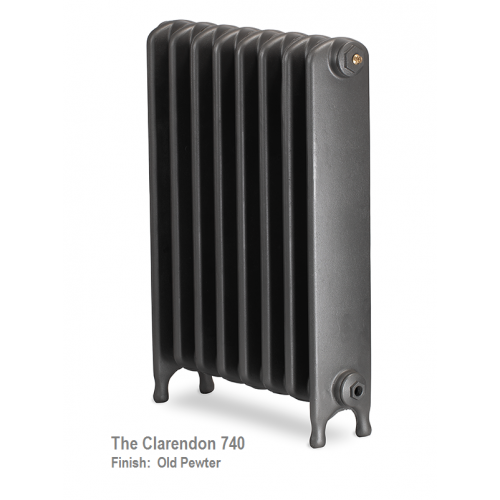
The Clarendon 740mm features a robust single column profile with rounded shoulders and wide spacing between sections. This design mimics the radiators used in Victorian schools and hospitals. Technically, the smooth casting and lack of ornate detailing allow for unrestricted airflow and easy cleaning between the columns. This prevents dust accumulation and makes it an ideal technical solution for environments where hygiene and air quality are priorities, such as for allergy sufferers.
Does the 145mm depth of the Clarendon 740mm radiator require special consideration for hallway installation regarding clear passage widths
Yes, the 145mm section depth is substantial. When planning your installation, you must technically account for the wall stay clearance (typically 20mm to 30mm), bringing the total projection from the wall to approximately 175mm. In narrow hallways or corridors, this deep profile can infringe on the required clear passage width or obstruct door swings. You should measure the available floor space carefully to ensure the radiator does not become a trip hazard or obstruction in escape routes.
What specific type of wall stay is technically mandatory for the top heavy Clarendon 740mm radiator to ensure safety
Although the radiator stands on its own integral feet, the 740mm height raises the center of gravity, making it potentially unstable if knocked. A Luxury Wall Stay (solid brass or chrome arm) is technically mandatory. This component clamps firmly between the cast iron sections and anchors the top of the radiator to the wall. It provides the necessary lateral tensile strength to prevent the heavy unit from tipping forward, ensuring compliance with safety standards.
Why is the Clarendon 740mm supplied in a Primer finish and what are the technical painting implications for the installer
The standard finish is a Black or White Primer, which is a transit coating designed only to prevent rust during storage. It is not a sealed finish. Technically, the installer or decorator must apply a final topcoat using an oil based eggshell or specialist metal paint to seal the cast iron against moisture and oxidation. Failure to apply this topcoat will eventually lead to surface rust, especially in damp environments like bathrooms. Alternatively, factory painted finishes like RAL colours are available for immediate protection.
Do I need a Cast Iron Radiator Joining Tool if I order a Clarendon 740mm radiator longer than 1200mm
Yes, for handling and safety reasons, cast iron radiators exceeding a certain length or weight (typically over 10 to 12 sections) are often shipped in smaller, manageable blocks. To assemble them on site, you require a Cast Iron Radiator Joining Tool and a set of Joining Nipples. This is a technical procedure where the nipples are screwed into the internal threads of the radiator sections using the tool, and significant torque is applied to compress the gaskets and create a watertight seal between the blocks.
Are the standard 1/2 inch BSP connections on the Clarendon 740mm compatible with modern thermostatic valves without adaptors
The Clarendon 740mm is cast with standard 1/2 inch BSP female tappings at the bottom corners. This ensures full technical compatibility with all standard UK radiator valves, including modern Thermostatic Radiator Valves (TRVs). You do not need reducers. However, due to the large scale and weight of the 740mm sections, it is aesthetically and mechanically preferable to use traditional style heavy pattern valves that visually balance the radiator and provide a robust connection point.
Why is a full system flush technically critical before commissioning the Clarendon 740mm radiator on an existing heating circuit
Cast iron radiators are manufactured using sand casting techniques. Microscopic residues of casting sand or metal filings can sometimes remain inside the waterways. Technically, it is vital to thoroughly flush the radiator and the entire heating circuit before final use. If this debris is not removed, it can circulate into the boiler, potentially damaging the pump impellers or blocking the heat exchanger channels. Installing a magnetic system filter is highly recommended to trap any ferrous debris and protect the boiler warranty.
How does the high thermal mass of the Clarendon 740mm radiator influence the heating schedule and energy efficiency of the property
The Clarendon 740mm has a very high thermal mass due to its water content and iron density. This results in a slow heat up and cool down cycle known as high thermal lag. Technically, you should adjust your heating timer to turn on 45 to 60 minutes before the room is needed. Conversely, the radiator will continue to emit useful radiant heat for over an hour after the boiler switches off. This flywheel effect provides a very stable, comfortable temperature, avoiding rapid fluctuations.
What if I order the wrong size?
Contact us immediately. Returns are possible but challenging due to weight measure carefully.