
Kensington - 750mm Products
Frequently Asked Questions
How does the increased height of the Kensington 750mm model affect the vertical clearance required for installation under standard window sills?
The Kensington 750mm specification refers strictly to the cast iron body height. When planning your installation you must account for the total vertical space which includes the 750mm body plus approximately 50mm to 100mm of clearance above the radiator to ensure proper air convection. If your window sill is lower than 850mm from the finished floor level you may need to opt for the shorter 580mm model to prevent heat from being trapped under the sill which would reduce efficiency.
Since the 39 section Kensington 750mm radiator weighs over 260kg do I need to reinforce my wooden suspended floor joists before installation?
Yes structural assessment is highly recommended for the larger configurations of the Kensington 750mm range. A 39 section model has a dry weight of roughly 265kg and once filled with water the total operating weight will approach 300kg. This creates a significant point load on floorboards. If you are installing this on a suspended timber floor you should ensure the feet are positioned directly over joists or add noggins and extra bracing between joists to prevent sagging or structural damage over time.
How does the larger water volume of the Kensington 750mm radiator impact the sizing of my central heating expansion vessel?
The Kensington 750mm model holds a greater volume of water per section compared to smaller panel radiators or the shorter 580mm version. If you are adding multiple large cast iron radiators to a sealed system you must calculate the total water content of the system. The expansion vessel must be sized to accommodate the expansion of this larger volume of heated water. An undersized vessel will cause system pressure spikes and may trigger the safety pressure relief valve.
What are the specific delivery and handling requirements for the Kensington 750mm radiator given its length of over 2.5 meters for large models?
Due to the extreme weight and length of models such as the 35 or 39 section Kensington 750mm they are often deemed unsafe to transport fully assembled. These large radiators will typically be delivered in two or three separate blocks to prevent damage during transit. You will need to use a Paladin Joining Key and joining nipples to assemble the radiator sections on site using a liquid gasket sealant or hemp to ensure a watertight seal before connecting valves.
Can I convert the Kensington 750mm Cast Iron Radiator into an electric only model using a standard heating element?
Converting the 750mm model to electric is possible but is limited by the wattage of available heating elements. Because the 750mm model has a high heat output per section roughly 100 Watts per section a standard 2000 Watt element can only effectively heat a radiator of up to 20 sections. If you require a Kensington 750mm radiator longer than 20 sections for electric use you may need a specialized setup with dual elements or you will have to accept a lower surface temperature output.
Why is the rough surface texture of the Kensington 750mm Cast Iron Radiator visible even after the Primer or Painted finish is applied?
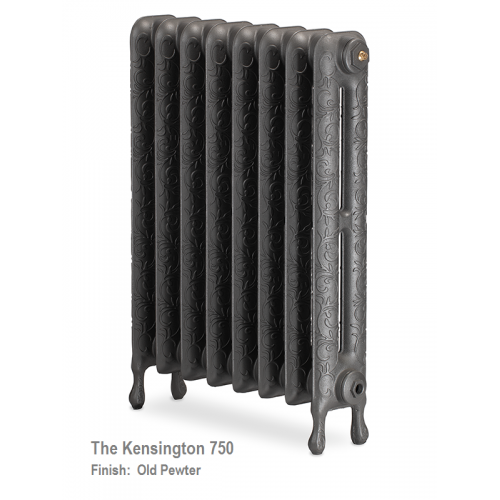
The Kensington range is manufactured using a traditional sand casting process which is identical to the methods used in the Edwardian era. This process naturally leaves a textured surface and minor pitting which validates the authenticity of the cast iron. The Primer and Heritage Painted finishes are sprayed over this texture but they do not fill it flat like a car body. This texture increases the surface area slightly aiding in heat radiation and gives the product its genuine period character.
How do I correctly balance the Kensington 750mm radiator in a system that also contains modern steel panel radiators?
Cast iron radiators heat up and cool down much slower than modern steel equivalents due to their high thermal mass. To balance the system you should adjust the lockshield valve on the Kensington 750mm radiator to restrict the flow slightly ensuring it does not rob heat from other radiators during the warm up phase. Conversely you may need to choke down the faster steel radiators to force more flow toward the cast iron unit ensuring all rooms reach temperature simultaneously.
What type of Wall Stay is required to secure the 750mm high Kensington model given its higher center of gravity?
Because the 750mm model is significantly taller than it is deep 145mm depth it has a higher center of gravity and is more prone to tipping if knocked. You should use a solid brass or steel Front Mounted Wall Stay or a Luxury Wall Stay that clamps between the sections. The stay must be anchored firmly into the masonry or a stud in the wall approximately near the top third of the radiator to provide the necessary leverage to prevent toppling.
Does the Kensington 750mm range offer a Polished Finish option and does this require different maintenance than the painted versions?
Yes the Kensington range is often available in Hand Polished or Satin Polished finishes where the outer layers of iron are buffed to a shine. Unlike painted radiators which are sealed against oxygen polished cast iron is exposed metal and is susceptible to surface rust if exposed to moisture. If you choose a Polished finish you must apply a light coat of oil or lacquer periodically to protect the metal and never install it in a high humidity environment like a bathroom without a protective clear coat.
How does the Delta T 60 rating for older boiler systems change the output calculation for the Kensington 750mm radiator?
The listed BTU output is typically at Delta T 50. If you have an older non condensing boiler system operating at higher temperatures closer to Delta T 60 the Kensington 750mm will actually produce roughly 20 percent more heat than the listed figure. Conversely if you are using a heat pump at Delta T 30 the output will drop by roughly half. You must apply the correct correction factor to the listed 3190 BTU (for 10 sections) to match your specific heat source temperature.