
Montpellier Cast Iron Radiator - 790mm High Products
Frequently Asked Questions
The Montpellier 790mm radiator weighs over 10kg per section; how does this impact the floor reinforcement requirements compared to the 590mm model?
The 790mm model is roughly 25% heavier than the 590mm version. A 10-section radiator weighs over 100kg empty and nearly 130kg when filled with water. This concentrated point load is substantial. For suspended timber floors, it is mandatory to verify the joist condition. You will almost certainly need to install a plywood sub-base or noggins between joists to distribute the load, preventing the feet from punching through the floorboards over time.
Does the 178mm depth of the Montpellier 790mm radiator require extended wall stays?
Yes. The 178mm depth puts the center of gravity far from the wall. Standard wall stays are often too short. You must use Luxury Wall Stays with a long threaded rod (typically cut-to-size). The stay must be anchored firmly into the masonry, not just plasterboard, to prevent this tall, heavy unit from tipping forward, which could be catastrophic given its weight.
Can I install the Montpellier 790mm radiator on a microbore (8mm/10mm) pipe system?
Absolutely not recommended. The water volume in a 790mm x 178mm section is vast. Microbore piping cannot deliver the flow rate required to heat this radiator evenly. The result would be a hot inlet and a cold radiator body. You must upgrade to 15mm copper pipework (or even 22mm for banks larger than 20 sections) to ensure adequate flow and full heat output.
How does the Scallop and Daisy motif affect the drying time if I paint the radiator on-site?
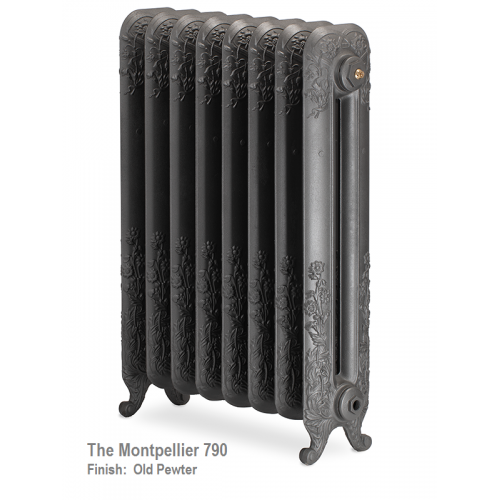
The deep relief pattern of the Montpellier range traps paint. If you apply a thick coat of oil-based paint, it will pool in the recesses and may take weeks to cure fully, remaining tacky. If you turn the heating on too soon, the paint will bubble. The technical solution is to spray multiple thin "mist" coats or use a high-quality aerosol metal paint to ensure even coverage without pooling.
What is the correct procedure for lifting a 300kg+ Montpellier 790mm radiator into position?
Do not lift by the end bushes. The sheer weight of a long Montpellier assembly can cause the gaskets to slip or the casting to crack if lifted by the ends. You must use lifting straps passed between the sections near the center of gravity. Ideally, disassemble the radiator into smaller banks (e.g., 10 sections max) for moving, then reassemble it in-situ using a joining key.
How much clearance do I need above the 790mm radiator for effective convection?
The 790mm height generates a strong convective draft. To allow this air to escape, you need a minimum of 100mm clearance above the top of the radiator (e.g., below a shelf or window sill). Restricting this gap will trap heat and significantly reduce the radiator's output efficiency.
Does the massive thermal mass of the Montpellier 790mm radiator affect my thermostat settings?
Yes. This radiator takes a long time to heat up (30-45 mins) but stays hot for hours after the boiler turns off. If you use a standard timer, the room may overheat after the heating cycle ends. You should use a smart thermostat with "Optimum Start/Stop" or TPI (Time Proportional & Integral) control, which learns the radiator's lag time and turns the boiler off early to utilize the stored heat, preventing overshooting.
Can I mix Montpellier 790mm radiators with modern aluminum radiators on the same circuit?
Technically yes, but it requires careful balancing. Aluminum heats up in minutes; the Montpellier takes 45 minutes. Without balancing, the aluminum radiators will heat the room and turn off the thermostat before the cast iron is even warm. You must "throttle down" the lockshield valves on the aluminum radiators to force flow to the cast iron unit and ensure the boiler runs long enough to heat the thermal mass of the Montpellier.