
Neo Georgian 4 360mm Products
Frequently Asked Questions
The Neo Georgian 4-Column 360mm radiator is very short; does this affect the convection currents compared to taller 660mm models?
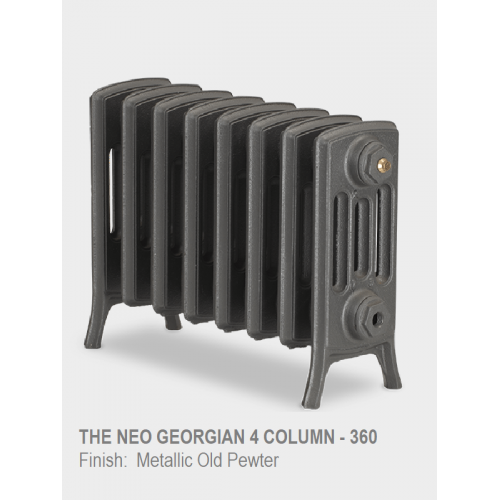
Yes. The 360mm height creates a much weaker "chimney effect" (natural convection) than taller radiators. This means it relies more on radiant heat emitted from its iron surface rather than circulating hot air around the room. To compensate for the reduced airflow, you generally need to size the radiator slightly larger (more sections) to ensure the radiant output is sufficient to heat the room comfortably.
With a depth of 144mm, can I install the Neo Georgian 4-Column 360mm radiator on a standard hallway wall without it obstructing passage?
The 144mm depth is relatively slim for a cast iron radiator (compared to the 221mm of the 6-column model). Including the required 25-30mm wall clearance, the front face will sit roughly 170mm - 175mm from the wall. This is generally acceptable for hallways, but you should check that it doesn't impede door openings or narrow walkways significantly. Using Corner Valves can help keep the pipework tucked within this footprint.
How do I calculate the pipe centers for the Neo Georgian 4-Column 360mm radiator for first-fix plumbing?
The pipe connections are centered within the 144mm depth, meaning they are 72mm from the back face of the radiator. Adding a recommended 30mm air gap means your pipes should exit the floor at approximately 102mm from the finished skirting board. This is wider than the standard 70mm rough-in for steel panel radiators, so you must adjust your pipework accordingly to avoid angled valve tails.
Is the 360mm height suitable for installation under a built-in window seat?
Yes, this is one of the primary applications for this model. The 360mm height allows for ample clearance under a standard bench height (450mm-500mm). However, you must install a grille or vent in the top of the window seat to allow the heat to escape. Without venting, the heat will be trapped in the boxed-in area, reducing efficiency and potentially damaging the joinery.
Does the lower weight (3.4kg/section) of the 360mm model mean I can skip floor reinforcement?
While lighter than the 960mm giants, a 30-section Neo Georgian 360mm radiator still weighs over 100kg dry and roughly 120kg wet. This is a significant static load. On a solid concrete floor, no reinforcement is needed. On a suspended timber floor, you should still check the condition of the joists. While less critical than for larger models, placing the feet over joists or using a spreader plate is still good technical practice to prevent long-term floor sag.
What is the maximum number of sections I can order for the Neo Georgian 4-Column 360mm radiator?
The Budget Radiators page lists options up to 40 sections (approx 2.4 meters long). However, shipping a 40-section radiator fully assembled is risky and difficult to handle (138kg). It is highly likely that radiators over 20-25 sections will be delivered in two batteries requiring on-site assembly with a joining key and nipples to ensure safe transport and ease of installation.
Can I mix the Neo Georgian 4-Column 360mm with the 6-Column version in the same room?
You can, as the aesthetic style (smooth, rounded columns) is identical. However, the depths are different (144mm vs 221mm). If you place them on the same wall, they will project differently. You must align the front faces for a visual match, which means the pipe centers for the 4-column unit will be closer to the wall than the 6-column unit, requiring complex pipework planning.
Does the 144mm depth provide enough surface area for efficient heat pump operation?
The 144mm depth is decent, but the low 360mm height limits the total surface area. At low flow temperatures (45
What is the water content of the Neo Georgian 4-Column 360mm radiator?
The 4-column 360mm section holds approximately 0.8 to 1.0 litre of water. A 20-section radiator holds ~20 litres. This is much less than the 6-column models, meaning the 360mm 4-column radiator will heat up faster (lower thermal inertia) than its larger cousins, making it slightly more responsive to thermostat changes.