
Piccadilly 660mm Products
Frequently Asked Questions
How does the intricate Celtic ribbon design of the Piccadilly 660mm radiator affect the heat emission characteristics compared to a smooth radiator of the same size?
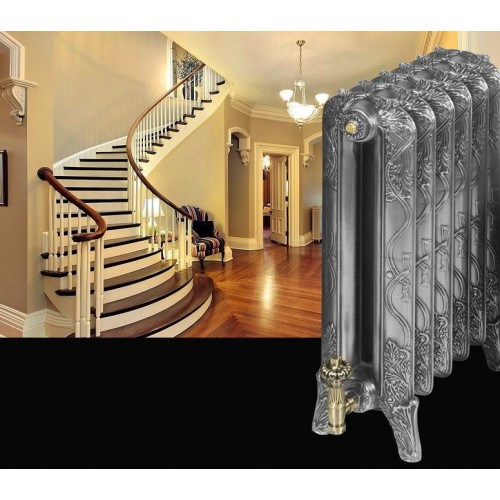
The Piccadilly 660mm features a complex raised pattern of Celtic ribbons and leaves. This increases the total surface area of the iron compared to a smooth column radiator of identical dimensions (660mm x 185mm). Technically, this enhanced surface area improves the radiant heat transfer into the room. However, the deep relief can also trap air pockets and dust, so while the potential emission is higher, maintaining it requires regular dusting to ensure the heat radiates freely from the iron surface.
I want to install the Piccadilly 660mm radiator under a dado rail; what vertical clearance is required for the convective airflow to work correctly?
The 660mm height often aligns closely with dado rails in Victorian properties. To ensure the chimney effect (convection) works efficiently, you need a minimum gap of 50mm (ideally 100mm) between the top of the radiator and any overhanging rail or shelf. If your dado rail is at 700mm, you only have 40mm clearance, which is borderline and may cause heat to build up behind the radiator, potentially cracking the plaster or warping the rail.
The Piccadilly 660mm has a depth of 185mm; does this require a specific type of angled valve for pipework coming from the wall?
Yes. The 185mm depth places the pipe centers approximately 92.5mm from the back of the radiator. If you include a 30mm wall clearance, your pipe centers will be ~122mm from the wall. Standard angled valves might protrude too far or look clumsy. We recommend using Corner Valves (where the head points horizontally or vertically) to keep the valve body tucked neatly within the 185mm footprint of the radiator, preventing it from becoming a trip hazard in a hallway.
What is the water content of the Piccadilly 660mm radiator per section, and does it require an additional expansion vessel?
The Piccadilly 660mm holds approximately 2.0 to 2.2 litres of water per section. A 20-section radiator holds over 40 litres. If you are adding this to an existing combi boiler system, the total system volume might exceed the boiler's internal expansion vessel capacity (usually ~8-10 litres, sufficient for ~100 litres total). You will technically need to calculate the total system volume and likely install an external expansion vessel (e.g., 18 litre) to accommodate the expansion of this large volume of water safely.
Is the Piccadilly 660mm radiator compatible with electric heating elements for dual-fuel use?
Yes, but with limitations. The 660mm height and 185mm depth provide good volume for an electric element. However, because it is a "column" radiator with gaskets, you must ensure the element is long enough to heat the water across the entire width. For long radiators (e.g., 15+ sections), a single element may leave the far end cool. You might technically need a dual-element setup or a specific circulation pump to ensure even heating in electric mode.
How does the weight of 9.4kg per section impact the choice of wall stays for the Piccadilly 660mm model?
A 10-section Piccadilly 660mm weighs nearly 100kg dry and 120kg wet. While it is stable on its feet, the 185mm depth means the center of gravity is forward-biased. You must use Luxury Wall Stays that clamp between the sections. Crucially, due to the 660mm height, the stay should be positioned in the top third (approx 500mm from floor). Anchoring into plasterboard is insufficient; you must locate a stud or use heavy-duty masonry anchors to prevent this heavy unit from tipping.
Does the 660mm height fit under a standard 800mm window sill with enough room for a TRV head?
Yes. A 660mm radiator under an 800mm sill leaves 140mm clearance. This is plenty of space for airflow. However, if you use a standard TRV (Thermostatic Radiator Valve) mounted on the top flow pipe, the head sits vertically. A standard TRV head is ~100-120mm tall. This might be a tight fit or look cluttered. We recommend using TRVs mounted on the bottom return or "Wheelhead" valves with a remote sensor if you want to keep the top line clean and accessible.
Can I assemble a 26-section Piccadilly 660mm radiator on-site to avoid lifting 245kg in one go?
Yes, and it is standard procedure. Radiators over 1.2m or 200kg are shipped in parts (e.g., two banks of 13 sections). You will need a Cast Iron Joining Tool and a set of joining nipples/gaskets. The technical process involves applying sealant to the gaskets, threading the nipples, and tightening them incrementally (top/bottom/top/bottom) to pull the faces together evenly. This must be done on a flat floor before lifting the radiator upright.