
Daisy 780mm Products
Frequently Asked Questions
How does the 780mm height of the Daisy Cast Iron Radiator specifically improve heat distribution in rooms with high ceilings
The 780mm height creates a significant vertical thermal channel. This technical dimension maximizes the chimney effect where cool air is drawn in at the floor level and accelerates upwards through the tall columns. This results in a powerful convection current that projects warm air higher into the room volume, making it a superior solution for heating period properties with tall ceilings compared to standard low level radiators.
What is the precise heat output per section for the Daisy 780mm model and how does this impact sizing calculations
Each individual section of the Daisy 780mm radiator generates approximately 362 BTUs or 106 Watts at Delta T50. To solve your sizing problem, you must divide the total heat loss requirement of your room by 362. For example, a dining room requiring 5500 BTUs would technically need a 15 or 16 section radiator. This high output per section allows you to heat large spaces without requiring an excessively wide radiator footprint.
Why is the floral casting of the Daisy 780mm radiator technically beneficial for heat emission as well as aesthetics
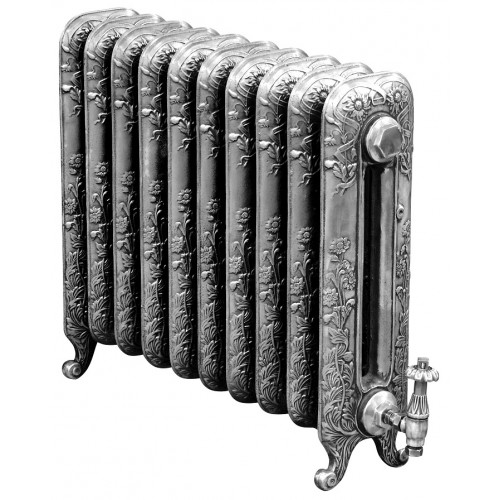
The Daisy range features an intricate relief pattern of flowers and ribbons cast directly into the iron. Beyond its visual appeal, this textured surface technically increases the total surface area of the radiator compared to a smooth column design of the same dimensions. This increased surface area improves the radiant heat transfer efficiency, allowing the radiator to emit more warmth into the room for its size.
What are the critical floor load requirements for installing the heavy Daisy 780mm radiator on suspended timber floors
The Daisy 780mm is a high density cast iron unit with each section weighing approximately 11.3 kg. A standard 10 section assembly weighs over 113 kg empty and significantly more when filled with water. Technically, you must ensure your subfloor can support this concentrated static load. For suspended timber floors, it is mandatory to position the feet directly over joists or install heavy duty timber noggins between joists to prevent structural bowing or floor failure.
Does the 175mm depth of the Daisy 780mm radiator require specific planning for wall stays and walkway clearance
Yes, the 175mm depth is substantial. When combined with the necessary wall stay clearance of 20mm to 30mm, the total projection from the wall is approximately 200mm. You must technically assess the floor plan to ensure this deep profile does not obstruct narrow hallways, door swings, or evacuation routes. The radiator requires a Luxury Wall Stay to clamp the sections securely to the wall, preventing the tall and heavy unit from tipping forward.
Why is the standard Grey Primer finish insufficient for the final installation of the Daisy 780mm radiator
The Grey Primer is a temporary transit coating applied at the foundry to inhibit rust during storage and shipping. It is porous and not a sealed cosmetic finish. Technically, you must apply a final topcoat using an oil based eggshell or specialist metal paint to seal the cast iron against oxidation and moisture. Installing the radiator without this final paint layer will lead to rapid surface rusting, particularly in humid environments like bathrooms or kitchens.
Do I need a Cast Iron Radiator Joining Tool if I order a Daisy 780mm radiator longer than 1200mm
For safety and manual handling reasons, radiators exceeding a certain length or weight (typically over 10 sections) are often shipped in smaller blocks. To assemble them on site, you require a Cast Iron Radiator Joining Tool and a set of Joining Nipples. This is a technical process where the nipples are screwed into the internal threads of the radiator sections using the tool, and high torque is applied to compress the gaskets and create a permanent watertight seal between the blocks.
Are the standard 1/2 inch BSP connections on the Daisy 780mm compatible with modern thermostatic valves
The Daisy 780mm is cast with standard 1/2 inch BSP female tappings at the bottom corners. This ensures full technical compatibility with all standard UK radiator valves, including modern Thermostatic Radiator Valves or TRVs. You do not need reducers. However, due to the ornate period style and the height of the radiator, it is aesthetically and mechanically preferable to use traditional style heavy pattern valves that visually balance the scale of the cast iron sections.
Why is a comprehensive system flush technically critical before commissioning the Daisy 780mm radiator
Cast iron radiators are manufactured using sand casting moulds. Microscopic residues of casting sand or metal filings can sometimes remain inside the waterways. Technically, it is vital to thoroughly flush the radiator and the entire heating circuit before final commissioning. If this debris is not removed, it can circulate into the boiler and damage the pump or heat exchanger. Installing a magnetic system filter is the recommended technical solution to trap any ferrous debris and protect the heating system.
How does the high thermal mass of the Daisy 780mm radiator improve heating comfort in draughty period properties
The Daisy 780mm has a very high thermal mass due to its heavy iron content and water volume. This results in a slow heat up and cool down cycle known as the flywheel effect. Technically, the radiator continues to emit effective radiant heat for over an hour after the boiler switches off. This creates a stable and consistent temperature curve which is ideal for combating the rapid heat loss and draughts often found in older period properties with single glazing.