
Ellipsis Single Horizontal Radiators Products
Frequently Asked Questions
How does the horizontal tube configuration of the TRC Ellipsis Single model technically influence the hydraulic flow path compared to vertical column radiators?
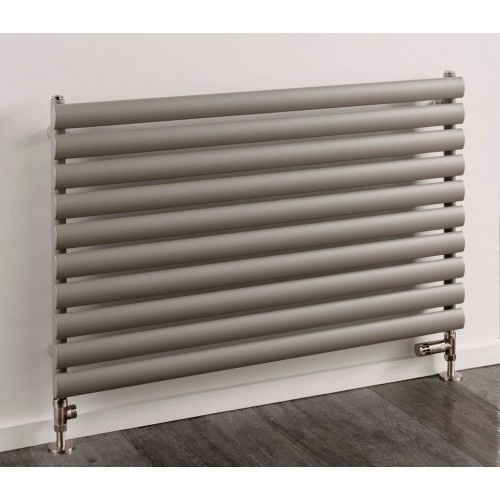
Unlike vertical column radiators where water rises and falls through vertical sections the Ellipsis Horizontal features horizontal oval tubes spanning between two vertical manifolds. Technically this creates a ladder style flow path. To ensure even heat distribution across the entire 1020mm or 1520mm width the system relies on the vertical collectors to distribute pressure evenly. It is critical that the flow enters the correct manifold (usually indicated by a baffle or specific flow diverter instructions) to prevent short circuiting where hot water bypasses the middle tubes.
With a listed depth of 95mm what is the specific calculation for the pipe center rough in distance from the finished wall surface for the Ellipsis Single Horizontal?
The depth of 95mm represents the total projection of the radiator from the wall to its front face when mounted. The connections are typically located on the underside of the vertical upright manifolds. The pipe centers (distance from wall to the center of the pipe) are usually positioned at approximately 65mm to 70mm from the finished wall. You must verify the specific bracket adjustment range provided in the installation manual as this can vary by +/- 10mm allowing for some tolerance on uneven walls.
Why is the Ellipsis Single Horizontal radiator with its 25mm x 50mm oval tubes technically preferred for low temperature systems like heat pumps over standard round tube radiators?
The elliptical tube profile of 25mm by 50mm offers a larger surface area to volume ratio compared to a standard 22mm round tube. Technically this increased surface area improves the radiant heat transfer coefficient. When operating at lower flow temperatures (Delta T 30) such as those from air source heat pumps this design maximizes the contact area with the ambient air allowing the radiator to emit useful heat more efficiently than round tubes which have less frontal surface area for the same volume of water.
What are the specific structural mounting requirements for the larger 1520mm width Ellipsis Single model given its mild steel construction and water weight?
Although it is a single layer model a 1520mm mild steel radiator filled with water exerts a significant shear load on the wall brackets. You technically cannot rely on plasterboard fixings (driva or toggle) alone. The brackets must be anchored into solid masonry or substantial timber noggins placed behind the plasterboard. The horizontal orientation creates a wide lever arm so proper leveling is critical to prevent stress on the pipe unions which could lead to weeping leaks at the valve tails over time.
Does the 10 year guarantee on the Ellipsis Single Horizontal cover galvanic corrosion if I install it on a mixed metal system containing copper and aluminium components?
The 10 year guarantee covers manufacturing defects in materials and workmanship but technically excludes failure caused by system corrosion. Mild steel radiators are anodic to copper pipework. To prevent galvanic corrosion and hydrogen gas generation (black sludge) you must chemically flush the system to BS7593 standards and add a high quality inhibitor (like Fernox F1 or Sentinel X100). Failure to maintain the correct pH and inhibitor levels will technically invalidate the warranty if pinhole corrosion occurs.
How does the thermal expansion coefficient of the mild steel Ellipsis radiator affect the installation of rigid copper pipework versus plastic piping?
Mild steel expands linearly when heated. For a long horizontal model like the 1520mm Ellipsis the thermal expansion can be noticeable (roughly 1mm per meter at 60C delta). If you pipe up using rigid copper with zero tolerance/flexibility this expansion can create ticking noises as the pipes rub against joists or stress the valve nuts. Technically you should allow for a small expansion loop or use flexible plastic pipework for the final connection (hidden in the wall) to absorb this movement and eliminate thermal noise.
Can I technically utilize a top bottom opposite end TBOE connection on the Ellipsis Single Horizontal to improve flow dynamics?
The Ellipsis Horizontal is designed with vertical manifolds at each end. While standard installation is often Bottom Bottom Opposite Ends (BBOE) technically utilizing a Top Bottom Opposite End (TBOE) connection can improve thermal efficiency by forcing water to travel diagonally across the entire matrix ensuring every horizontal tube is fully active. However you must check that the specific model provided has 1/2 inch BSP tappings at the top and that the air vent position is compatible with this setup to avoid air locks.
What is the recommended cleaning protocol for the horizontal oval tubes to prevent convective efficiency loss due to dust bridging?
Horizontal tubes collect dust on their top surfaces more than vertical tubes. A layer of dust acts as an insulator technically reducing the convective heat output. Because the Ellipsis tubes are spaced closely (typically 50mm gaps) you should use a specialized flat microfiber radiator brush or compressed air duster. You must clean between the tubes regularly to maintain the aerodynamic airflow that drives the convection current otherwise the stated BTU output will degrade over time.
If I need to balance the Ellipsis Single Horizontal against a high output double panel radiator in the same zone what specific hydraulic adjustments are required?
The Ellipsis Single has a lower water content and lower resistance than a large double panel radiator. Water follows the path of least resistance. Without balancing the flow will rush through the Ellipsis returning to the boiler too hot while starving the larger radiator. You must technically throttle down the lockshield valve on the Ellipsis (potentially closing it by 70 to 80 percent) to increase its hydraulic resistance. This forces the system pressure to push water into the more restrictive double panel radiator ensuring both heat up evenly.
How does the single layer configuration of the Ellipsis Horizontal limit the total heat output per linear meter compared to the double version and how should I size it?
The single configuration has only one row of tubes meaning it relies heavily on radiation from the front face and convection from the back. The double version adds a second row increasing surface area but also increasing "shadowing" where the back row is less efficient. Technically the single version is roughly 60 to 70 percent of the output of the double version for the same dimensions. If you are constrained by the 95mm depth limit of the single model you must compensate by selecting a wider or taller size to achieve the required BTU load for the room.