
Ellipse Oval Manual Range Products
Showing 1 to 1 of 1 (1 Pages)
Frequently Asked Questions
How do I technically confirm if the Ellipse Oval Manual Valve is compatible with my specific designer radiator?
To ensure technical compatibility, you must verify the tapping size of your radiator. The Ellipse Oval Manual Valve is manufactured with a standard 1/2 inch BSP (British Standard Pipe) threaded tail. This is the universal standard for 99 percent of radiators sold in the UK, including designer oval tube models, heated towel rails, and standard panel radiators. If your radiator has 1/2 inch connection ports (which are approximately 21mm in diameter physically), this valve will screw in directly and seal perfectly using PTFE tape or jointing compound.
Why is the Ellipse Oval range only available as a manual valve and not as a thermostatic option?
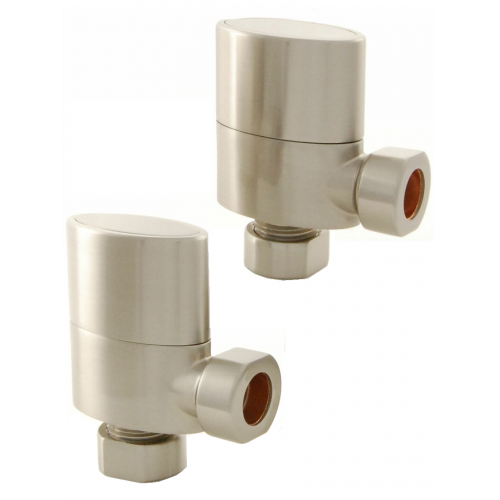
The decision to make the Ellipse range manual is a specific technical design choice driven by aesthetics. A thermostatic valve head must rotate to adjust the temperature setting, which would cause an oval-shaped head to sit at odd, non-symmetrical angles (e.g., upside down or sideways). By keeping the mechanism manual, the internal spindle lifts up and down while the oval handle remains fixed in a perfectly aligned position. This ensures that the clean lines of your designer radiator are never disrupted by a crooked valve head.
What is the correct technical configuration (Angled, Straight, or Corner) for my pipework layout?
Selecting the correct configuration is critical for a tension-free installation. Angled Valves: Use these if your pipes come up from the floor and connect to the side of the radiator. Straight Valves: Use these if your pipes run along the wall and connect into the side, or if they come up from the floor and connect to the bottom underneath of the radiator. Corner Valves: Use these if your pipes come out of the wall and connect to the side. Technically, this is often better than Angled valves for wall pipes because it keeps the valve head pointing upwards rather than protruding into the room, preventing accidental knocks.
How do I install Ellipse Oval Valves on 10mm or 8mm microbore pipework?
The Ellipse Oval Valve comes with a standard 15mm compression inlet. If your central heating system uses smaller microbore pipework (common in new builds from the 1980s/90s), you do not need to buy a different valve. Instead, you must use a "reducing set" or "olive reducer." This is a small brass component that fits inside the 15mm valve inlet and clamps down onto the 8mm or 10mm pipe. You simply remove the standard 15mm olive, insert the reducer, and tighten the nut. This creates a high-pressure watertight seal without altering the external appearance of the valve.
How does the manual operation of the Ellipse valve technically differ from a simple on/off tap?
While the Ellipse valve operates like a tap (turn clockwise to close, anti-clockwise to open), it is technically a "regulating valve." Inside the brass body, there is a fine-threaded spindle that allows for precise adjustment of the water flow rate. It is not just fully open or fully closed; you can partially open it to limit the flow. This is crucial for "balancing" your system, ensuring that the radiator gets enough hot water to reach its full heat output without starving other radiators in the loop.
What maintenance is required to keep the Satin Nickel or Chrome finish of the Ellipse valve in perfect condition?
To maintain the 10-year guarantee and the visual quality of the finish, you must avoid all acidic, caustic, or abrasive cleaning agents. Technically, the plating on these valves is durable, but harsh chemicals (like bleach or heavy-duty limescale removers) can cause microscopic pitting or strip the protective lacquer. The correct problem-solving maintenance is to clean the valve using only a soft cloth dampened with warm water. If the valve is in a bathroom, regular wiping prevents the buildup of condensation which can eventually lead to surface oxidation.
Can I use the Ellipse Oval Manual Valve on a dual-fuel heated towel rail?
Yes, the Ellipse Manual Valve is the technically preferred option for dual-fuel systems. In a dual-fuel setup, you have an electric element and central heating pipes connected to the same rail. When the heating is off and you switch the electric element on, you must technically isolate (close) one valve to allow for expansion or leave one slightly open to prevent pressure buildup, depending on the specific element type used (sealed vs. vented). A manual valve gives you positive, unchangeable control over this, whereas a thermostatic valve might open or close automatically based on air temperature, which could be dangerous in a sealed electric system.
How do I balance my heating system using the Ellipse Oval Manual Valve set?
Your Ellipse set includes two valves: one acts as the "Wheelhead" (flow control) and the other as the "Lockshield" (balance control). Although they look identical for symmetry, you use the one on the return pipe (where water leaves the radiator) as the Lockshield. To balance the system, close this valve fully, then open it only a quarter or half turn. This restricts the water speed, forcing the pump to push hot water to radiators further away. This technical adjustment ensures that all radiators in your house heat up at the same speed.
Will the Ellipse Oval Valve handle fit if my radiator is installed very close to a wall or corner?
The Ellipse valve head is designed with a low profile to solve exactly this problem. The oval shape is wider (approx 92mm) but has a slimmer depth compared to bulky traditional round knobs. However, during installation, you must check the "wall distance" (the gap between the radiator tapping and the wall). If you are using a Corner valve configuration, the head will sit parallel to the wall, requiring minimal clearance. If you use an Angled valve on wall pipes, the head points into the room, so wall clearance is less of an issue, but it protrudes more.
Why is a manual valve like the Ellipse recommended for bathrooms or rooms with a main wall thermostat?
Technically, you should never install a thermostatic valve in the same room as your main central heating wall thermostat. If you do, the two thermostats will compete (e.g., the valve shuts the radiator off before the wall thermostat reaches temperature), causing the boiler to cycle on and off inefficiently or never turn off. The Ellipse Manual Valve solves this by providing a constant, unchecked flow of heat. This allows the main wall thermostat to accurately read the true room temperature and control the boiler cycles correctly.