
Ellipsis Double Horizontal Radiators Products
Showing 1 to 4 of 4 (1 Pages)
Frequently Asked Questions
How do I accurately calculate the pipe centres for the Ellipsis Double Horizontal Radiator given its substantial 125mm depth to ensure correct roughing in
To solve the installation layout for the Ellipsis Double Horizontal, you must account for its fixed depth of 125mm which is deeper than standard panel radiators. Technically, the pipe centres are calculated by taking half of this depth (62.5mm) and adding the necessary wall clearance (typically 50mm to allow for the mounting brackets). This means your copper pipework should be roughed in at approximately 112.5mm from the finished wall surface to ensure the radiator hangs vertically without stress on the valves.
Why does the Ellipsis Double Horizontal Radiator produce significantly higher BTU output compared to the single version and is it suitable for large open plan spaces
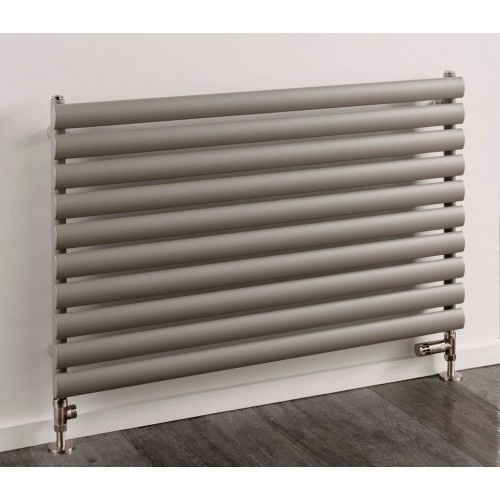
The Ellipsis Double Horizontal achieves high outputs, such as 5435 BTUs for the 1520mm wide model, because it features two rows of oval steel tubes arranged back-to-back. This technical configuration doubles the surface area available for both radiation and convection within the same wall footprint. It effectively solves the problem of heating large open-plan rooms or areas with high heat loss where wall space is limited, as it delivers the thermal performance of two radiators in one unit.
What are the structural mounting requirements for the Ellipsis Double Horizontal Radiator considering the weight of the water in the double row of tubes
While made of steel, the Ellipsis Double Horizontal holds a significant volume of water due to its dual-layer construction. For example, the 1520mm model requires secure fixing to solid masonry walls or timber studs. You technically cannot rely on plasterboard fixings alone. To solve potential stability issues, you must locate the studs or use chemical anchors in brickwork to ensure the brackets can support the combined weight of the steel and the water load without pulling away from the wall.
Does the 10 Year Guarantee on the TRC Ellipsis Double Horizontal cover rust formation if the radiator is installed in a high humidity bathroom
The 10 Year Guarantee covers manufacturing defects and material failure, but technically, standard steel radiators like the Ellipsis are not designed for direct contact with water or excessive humidity zones (like inside a wet room shower area). To solve the problem of corrosion and maintain your warranty, you should ensure the bathroom is well-ventilated. If rust appears due to constant surface condensation or lack of internal inhibitor, this is considered an environmental or maintenance issue rather than a manufacturing fault.
How does the oval tube design of the Ellipsis Double Horizontal affect the airflow and convective efficiency compared to standard round columns
The technical advantage of the Ellipsis oval profile is that it creates a smoother aerodynamic channel for air to rise between the tubes compared to round columns. In the Double Horizontal configuration, this shape encourages a "chimney effect" between the front and rear layers, accelerating the convective airflow. This solves the problem of stagnant heat, ensuring that warm air is projected into the room more effectively while maintaining a sleek, modern aesthetic that is easier to wipe clean than complex fins.
What type of valves are technically best suited for the Ellipsis Double Horizontal Radiator if my pipes are coming up from the floor
Since the Ellipsis Double Horizontal has side connections and a depth of 125mm, using Angled Valves is the most technically appropriate solution for floor-sourced pipes. Angled valves allow the pipes to rise vertically from the floor and turn 90 degrees into the side of the radiator. This keeps the pipework tidy and minimizes the trip hazard, solving the aesthetic issue of having pipes jutting out into the room which would occur if you used straight valves on such a deep radiator.
Why is the delivery time listed as 20 to 30 days for the larger 1520mm Ellipsis Double Horizontal model while others are in stock
The larger 1520mm Ellipsis Double Horizontal model is often a special order item due to its size and specific manufacturing requirements. While smaller sizes like the 1020mm are typically stocked for immediate dispatch, the larger units are brought in or finished to order. To solve project timeline issues, you must technically factor in this lead time when scheduling your plumber, ensuring you do not book installation dates until you have a confirmed delivery slot for these larger, high-output units.
Can the Ellipsis Double Horizontal Radiator be used on a low temperature heat pump system given its Delta T 50C rating of 5435 BTUs
Yes, the Ellipsis Double Horizontal is technically an excellent candidate for heat pump systems because of its high surface area. However, heat pumps run at lower temperatures (Delta T 30C or 40C), so the actual output will be lower than the listed 5435 BTUs (Delta T 50C). To solve this, you must apply a correction factor (roughly multiplying by 0.51 for Delta T 30C) to confirm the radiator still meets your room's heat loss requirements. Its double-layer design helps compensate for the lower water temperature.
How do I effectively clean the dust from between the two rows of tubes on the Ellipsis Double Horizontal Radiator to maintain heat transfer efficiency
The 125mm depth and double row of tubes can trap dust, which acts as an insulator and reduces convective heat output. To technically solve this maintenance problem, you should use a long, flexible radiator brush or a vacuum cleaner with a narrow nozzle attachment to reach between the oval tubes. Regularly removing dust buildup from the central gap ensures that air can flow freely between the front and back layers, maintaining the maximum BTU output of the unit.
What is the impact of the 125mm depth on the choice of location for the Ellipsis Double Horizontal in a narrow hallway or behind a door
The 125mm depth of the Ellipsis Double Horizontal is significant and, when combined with the required wall clearance, can project over 175mm into the room. Technically, this makes it unsuitable for installation behind standard internal doors, which would strike the radiator when fully open. To solve this spatial problem in narrow hallways, you should strictly measure the swing radius of any nearby doors or consider a slimmer single-panel version if the projection creates an obstruction or safety hazard.