
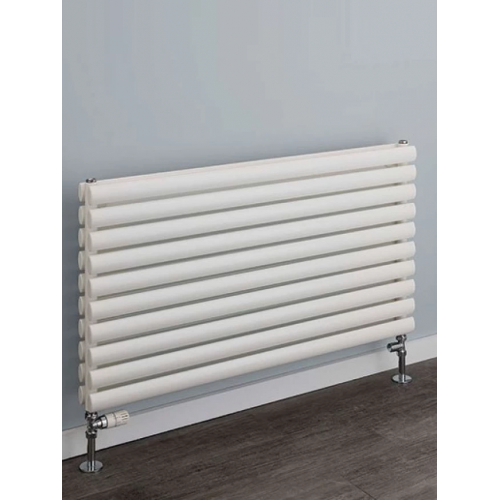
The Oval Double Horizontal - Made to Order Products
Frequently Asked Questions
Why is the manufacturing lead time for the Oval Double MTO range typically 5-6 weeks compared to the 2-3 weeks for single panels?
The double configuration requires a more complex manufacturing process. The two panels must be individually welded, pressure tested, and then technically joined using a collector manifold or inter-panel connections. This assembly must then be powder coated as a complete unit (or in stages) to ensure the coating reaches the inner surfaces between the panels. This intricate fabrication and the need for double the material curing time in the oven extend the production window.
How does the heat output density of the Oval Double Horizontal (e.g., 9400 BTU for the 780x2020mm model) impact the balancing of a standard domestic heating loop?
A single radiator with such a massive output (nearly 3kW) draws a significant flow rate from the boiler. If installed on a loop with smaller radiators, it can technically "starve" the rest of the system if not balanced correctly. You must use the lockshield valve to restrict the flow slightly, ensuring a Delta T (temperature drop) of 12
Is the Oval Double MTO radiator suitable for low-temperature heat pump systems running at 45°C flow temperature?
Yes, the Double Oval design is technically ideal for heat pumps. The double layer of tubes provides a massive surface area in a compact footprint, compensating for the lower water temperature. A unit rated at 5000 BTU at Delta T50 might still deliver ~2400 BTU at Delta T30 (Heat Pump levels), which is often sufficient to heat a room where a single panel would fail.
What happens if I order a custom Oval Double Horizontal radiator and the "White RAL 9016" finish doesn't match my other "White" radiators?
"White" is not a universal standard. Most "stock" radiators are RAL 9016 (Traffic White), but some older ones are RAL 9010 (Pure White) which is creamier. The MTO range uses a fresh powder coat of RAL 9016. Technically, a brand new bright white radiator can make existing older radiators look yellowed or "off-white" by comparison due to UV aging. You should be prepared for this visual contrast or consider re-spraying older units.