
Bartholomew 570mm Products
Frequently Asked Questions
Why is the Bartholomew 570mm Cast Iron Radiator technically classified as a Hospital Style radiator and what is the benefit?
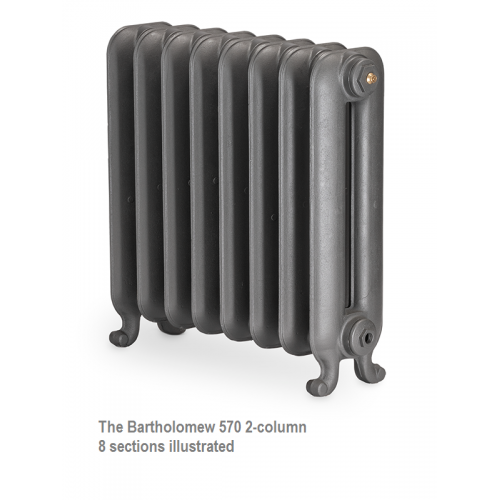
The Bartholomew 570mm is a faithful reproduction of the Victorian hospital radiator. Technically, this design features wide, smooth sections with significant spacing between each column and no ornate detailing or intricate crevices. This smooth profile was originally engineered to prevent dust accumulation and allow for easy cleaning and sterilization in medical environments. Today, this technical feature makes it an excellent choice for allergy sufferers or modern minimalist interiors where hygiene and ease of maintenance are priorities.
What is the heat output per section for the Bartholomew 570mm model and how does its depth affect thermal performance?
Each section of the Bartholomew 570mm radiator generates approximately 293 BTUs (86 Watts) at Delta T50. While this is a lower vertical height, the radiator has a substantial depth of 174mm. This deep profile creates a large surface area for radiant heat emission. To calculate your total requirement, divide your room's heat loss by 293. For example, a 10-section model delivers 2930 BTUs, providing a powerful, steady heat source ideal for maintaining temperature in large open-plan rooms.
What are the structural floor load requirements for installing the heavy Bartholomew 570mm radiator?
The Bartholomew 570mm is exceptionally heavy due to its dense, wide-profile casting. A single section weighs approximately 7 kg. A standard 10-section assembly weighs 70 kg empty and close to 85-90 kg when filled with water. Technically, you must verify that your floor structure can support this concentrated weight. If installing on suspended timber joists, you should position the feet directly over the joists or install noggins (reinforcing timber) between them to distribute the load and prevent floor deflection.
Does the 174mm depth of the Bartholomew radiator create specific installation challenges regarding wall projection?
Yes, the 174mm depth is significantly deeper than standard panel radiators or even other cast iron models like the Victorian. When you add the required clearance for the wall stays (approx 20-30mm), the total projection from the wall into the room will be close to 200mm. You must technically assess your floor plan to ensure this projection does not encroach on walkways, obstruct door swings, or interfere with furniture placement, particularly in narrow hallways.
Why is the Bartholomew 570mm radiator supplied in a Primer finish and what painting specification is required?
The radiator is supplied in a standard Black or White Primer. This is a transit coating to prevent rust during shipping and is not a finished surface. Technically, the cast iron surface is porous. You must apply a final topcoat to seal the metal against oxidation. We recommend using an oil-based eggshell or specialist radiator paint. Water-based emulsion paints should be avoided as they can cause flash rusting on the iron before they dry. Alternatively, you can order a factory-applied "Carron Metallic" or "RAL" topcoat for immediate protection.
What type of Wall Stay is required for the Bartholomew 570mm and is it structural?
Due to its substantial depth and weight, the Bartholomew 570mm is freestanding. However, for safety, a Luxury Wall Stay is technically mandatory. This brass or chrome arm clamps the radiator sections to the wall to prevent the unit from tipping over if knocked. It does not bear the vertical weight (the feet do that), but it provides essential lateral stability. Given the 570mm height, the stay should be positioned near the top of the radiator to offer the maximum leverage against tipping.
How does the high thermal mass of the Bartholomew 570mm radiator affect the heating cycle of the room?
Cast iron has a high specific heat capacity and high density. The Bartholomew 570mm takes longer to heat up than an aluminium or steel radiator (high thermal lag), but it retains heat for much longer. Technically, this means the radiator will continue to emit warmth for up to an hour after the boiler has switched off. This "flywheel effect" creates a very stable, comfortable room temperature, avoiding the rapid hot-cold cycles associated with low-mass modern radiators.
Are the connection tappings on the Bartholomew 570mm compatible with standard valves or are reducers needed?
The Bartholomew 570mm is cast with standard 1/2 inch BSP female connections at the bottom corners. This ensures full technical compatibility with all standard UK radiator valves, including modern Thermostatic Radiator Valves (TRVs). You do not need reducers. However, due to the wide styling of the radiator, it is recommended to use "traditional" style valves (such as the Crocus or Bentley range) which are physically larger and visually balanced with the chunky proportions of the radiator sections.
Do I need a special joining tool if I order a Bartholomew 570mm radiator longer than 10 sections?
Budget Radiators typically ships cast iron radiators fully assembled on pallets up to a safe handling length (often 10-15 sections). If you order a very long assembly (e.g., 20+ sections) or have restricted access, it may be shipped in two parts. In this case, you will technically require a Cast Iron Radiator Joining Tool and joining nipples. Assembling cast iron requires significant torque to compress the graphite/fibre gaskets and ensure a watertight seal, so this should ideally be performed by a professional installer.
Why is flushing the heating system critical before connecting the Bartholomew 570mm radiator?
Cast iron radiators are sand-cast, and microscopic residues of casting sand or metal filings can sometimes remain inside the sections. Technically, it is vital to thoroughly flush the radiator and the pipework before final commissioning. If this debris enters the heating circuit, it can damage pump impellers or block heat exchanger channels. A system power flush combined with the installation of a magnetic system filter is the best technical practice to protect your boiler when retrofitting cast iron radiators.