
Kensington - 580mm Products
Frequently Asked Questions
How do I accurately calculate the required number of sections for a Kensington 580mm High Cast Iron Radiator to heat my room efficiently?
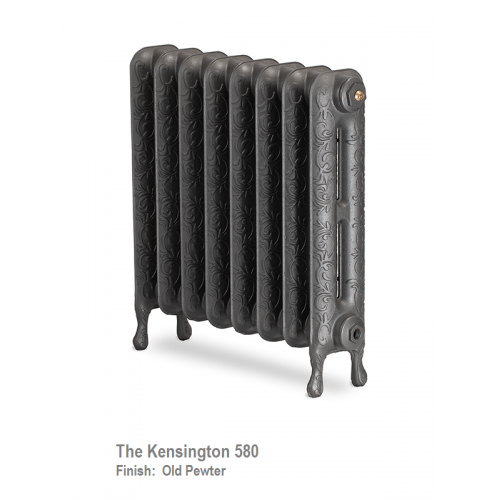
To determine the correct size, you must first calculate the heat loss of your room to find the required BTU or Watts output. Once you have this figure, divide it by the output per section of the Kensington model (approximately 240 BTUs per section at Delta T 50). This will give you the total number of sections needed. You must also verify that the resulting width (e.g., 17 sections is 1241mm wide) fits your available wall space, allowing for valve extensions on either side.
What does the listed BTU Output at Delta T 50 degrees Celsius mean for this radiator and how does it affect compatibility with heat pumps or older boilers?
Delta T 50 represents the difference between the average water temperature inside the radiator and the desired room temperature, which is the standard rating for gas boilers. If you are using a low-temperature system like a heat pump (often Delta T 30) or an older oil system (Delta T 60), the actual heat output of the Kensington Cast Iron Radiator will vary. You will need to apply a correction factor to the listed 580mm height specifications to ensure the radiator is large enough to provide adequate warmth at lower water temperatures.
Why is the distinction between the Primer Black or White finish and the Heritage Metallic finishes critical for the installation process?
The Primer Black and Primer White options are base coats only and are not intended as final cosmetic finishes. If you purchase a Kensington radiator in primer, you must paint it with a suitable metal paint to prevent rust and seal the cast iron. Conversely, the Heritage Metallic Finishes and other custom options are fully finished topcoats, meaning the radiator is ready for immediate installation without any additional painting work required on site.
Given the significant weight of the Kensington Cast Iron Radiator range, do I need to install Wall Stays even though the radiator has feet?
Yes, installing Wall Stays is a critical safety requirement for all Paladin Kensington radiators. Although the feet support the heavy vertical weight (up to 216kg for large models), cast iron radiators are top-heavy and narrow (145mm depth). Wall Stays anchor the radiator to the wall to prevent it from accidentally tipping over if bumped or pulled, ensuring structural stability without bearing the vertical load of the unit.
How do I calculate the total installation width including radiator valves for the Kensington 580mm model to ensure it fits between my pipework?
The widths listed on the product page (e.g., 602mm for 8 sections) refer strictly to the radiator body. To calculate the total installation width required for your pipe centers, you usually need to add approximately 80mm to 100mm to the listed width. This extra space accommodates the radiator valves and the threaded tails that connect the valves to the radiator bushes on either side.
Does the Kensington 580mm Cast Iron Radiator arrive fully assembled or will I need a joining tool to connect the sections on site?
Smaller configurations typically arrive fully assembled on a pallet. However, very long radiators (typically those exceeding 1.2 meters or a specific weight limit) may be shipped in two or more parts to ensure safe transport and handling. In these cases, you will need a specific Joining Key tool and joining nipples to assemble the radiator halves on-site before connecting it to your heating system.
What specific maintenance is required for the Kensington Cast Iron Radiator to prevent corrosion and maintain the 10 year guarantee?
To protect the cast iron from internal corrosion and maintain the guarantee, you must flush the heating system to remove debris and add a high-quality central heating inhibitor suitable for mixed-metal systems. You should also periodically bleed the radiator to remove trapped air, which can cause cold spots and accelerate internal rusting. Externally, avoid drying wet laundry directly on the radiator surfaces as this can damage the paint finish and encourage rust.
How does the high thermal mass of the cast iron material affect the heating curve and energy efficiency of my home?
Cast iron has a high thermal mass, meaning the Kensington radiator takes longer to heat up than steel or aluminium equivalents, but it also retains heat for much longer after the boiler switches off. This creates a more consistent and ambient temperature profile in the room, smoothing out sharp drops in temperature. It is ideal for main living areas where a steady, comfortable heat is preferred over rapid, on-demand bursts of heat.
Can I install the Kensington 580mm High radiator on an existing microbore piping system or do I need standard copper pipework?
Cast iron radiators generally have a large water volume and require good flow rates to perform effectively. While it is physically possible to use adapters for microbore pipework (8mm or 10mm), it is not recommended for large cast iron radiators as the restricted flow may prevent the radiator from reaching its full temperature across all sections. Standard 15mm copper pipework is strongly advised to ensure the 580mm Kensington achieves its rated BTU output.
What is the exact depth of the Kensington 580mm model and how far will it project from the wall once installed?
The section depth of the Kensington 580mm model is fixed at 145mm. However, the total projection from the wall depends on where you position the feet relative to the skirting board. Typically, the center of the pipe will sit roughly 70mm to 100mm away from the wall. This results in the front face of the radiator projecting approximately 160mm to 180mm into the room, which must be accounted for when placing furniture or opening doors nearby.