
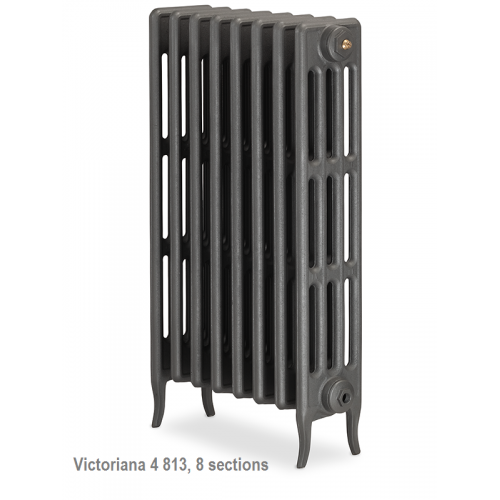
Victoriana 4 - 813mm Products
Frequently Asked Questions
Considering the 38 section model weighs a massive 245kg (estimated based on similar sizing) before filling what specific structural reinforcement is required for suspended timber floors
A 245kg static load, which increases significantly when filled with water (adding approx. 3-4kg per section), creates a severe point load hazard for standard timber joists. You strictly cannot install this directly onto floorboards. You must technically reinforce the floor by installing noggins between joists and potentially using a steel spreader plate or a concrete plinth to distribute the weight. It is also advisable to position the radiator legs directly over the joists where possible to transfer the load vertically.
Why does the Victoriana 4 813mm High model offer such a high BTU output of 12888 BTUs for the 36 section version and is it suitable for modern insulated homes
The 12888 BTU output is achieved through the combination of 4 columns and the increased 813mm height, creating a massive surface area for convection. While this is excellent for large, drafty period rooms with high ceilings, it may be technically oversized for modern, well-insulated properties. In such cases, you should install Thermostatic Radiator Valves (TRVs) to modulate the flow, or technically opt for a shorter radiator length (fewer sections) to avoid overheating the space and causing system cycling.
What is the technical impact of the 813mm height on the system's hydraulic balance when installed alongside standard 600mm panel radiators
Mixing the 813mm high Victoriana 4 with standard height radiators can create hydraulic imbalances due to the difference in static head and water volume. The taller radiator may act as a preferential path or a heat sink depending on the piping layout. To solve this, you must technically balance the lockshield valves across the entire system, potentially restricting flow to this large radiator to ensure that smaller, downstream radiators receive adequate hot water and heat up simultaneously.
Given the 4 column design and 813mm height how does this radiator perform with low temperature heating systems like Ground Source Heat Pumps (GSHP)
The Victoriana 4 813mm is technically ideal for GSHP systems because its large surface area and high water content compensate for the lower flow temperatures (35-45
Does the 10 Year Guarantee cover leakages caused by the degradation of inter-section gaskets due to thermal expansion in this large cast iron mass
The 10 Year Guarantee covers manufacturing defects, including gasket failure under normal operating conditions. However, the large mass of the 813mm high model undergoes significant thermal expansion and contraction. If the system is shocked with rapid temperature changes (e.g., turning a cold system to max heat instantly), it can stress the gaskets. Technically, the guarantee remains valid provided you use a gradual heating curve and, crucially, maintain the correct level of corrosion inhibitor to keep the gaskets supple.
How do I technically secure the 813mm High Victoriana 4 to the wall given its high center of gravity and 158mm depth to prevent tipping
The 813mm height combined with a narrow base relative to its height raises the center of gravity, making stability a safety critical issue. Standard wall stays are insufficient. You must use "heavy duty" or "luxury" wall stays that are long enough to bridge the gap created by the 158mm depth. These stays must be anchored into solid masonry or timber studs, not just plasterboard, and clamped firmly to the rear columns to mechanically prevent the radiator from toppling forward.
How does the internal water volume of the Victoriana 4 813mm compare to steel radiators and what does this mean for inhibitor dosing
This model holds a significantly higher volume of water per section than a steel panel radiator (often 3-4 times more). When retrofitting or installing these, you cannot simply add the standard "1 bottle per 10 radiators" dose of inhibitor. You must technically calculate the total system volume (often 100+ liters for a system with several of these) and dose the inhibitor chemically based on concentration levels (usually 1% or as specified) to ensure full protection against corrosion and hydrogen gas build-up.