
Colona 3-Column Radiators Products
Frequently Asked Questions
How do I structurally secure the heavy Reina Colona Horizontal 3-Column radiator to a standard plasterboard stud wall without risking the fixings pulling out due to the sheer weight of the water filled unit?
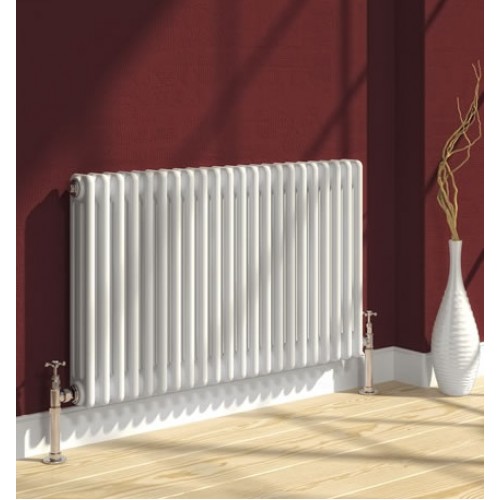
The horizontal 3-column models hold a significant volume of water which makes them heavy. To solve this on a stud wall you must locate the vertical timber studs behind the plasterboard and anchor the wall brackets directly into this wood for maximum pull out resistance. If the bracket positions do not align with the studs you should install a horizontal timber noggin between the studs prior to plastering or use specific Reina slip on feet to transfer the majority of the vertical weight load directly to the floor rather than the wall.
What is the technical impact of the 3-column configuration on the thermal efficiency and convection rates compared to a standard Type 22 panel radiator of the same horizontal width?
The 3-column design offers a superior ratio of surface area to air volume which enhances the convection effect. While a Type 22 panel traps dust and relies heavily on internal fins the Reina Colona 3-Column allows air to circulate freely around each individual tube. This generates a more consistent rising column of warm air that heats the room volume evenly from floor to ceiling making it a highly effective solution for rooms with high ceilings where pushing heat upwards is the primary objective.
When installing the wider 1370mm Colona Horizontal models is it technically necessary to configure the flow and return valves at opposite ends to prevent short cycling of the hot water?
Yes specifically for the wider horizontal models installing the flow valve on one side and the return valve on the opposite side is the correct hydraulic practice. This Bottom Opposite End or BOE configuration forces the hot water to travel the entire length of the radiator manifold before exiting. This prevents the water from short circuiting where it might otherwise flow in and out of the same side leaving the far end of the long radiator cold and reducing the total BTU output.
How does the low carbon steel construction of the Colona 3-Column range technically differ from traditional cast iron in terms of thermal response time and heat retention properties?
Low carbon steel has a much lower thermal mass than cast iron which solves the problem of slow warm up times. The Reina Colona will reach its maximum operating temperature much faster than a cast iron equivalent which is ideal for modern programmable thermostats where you need heat immediately upon the system switching on. However it also cools down faster so you should program your heating timer to turn off slightly later than you would with cast iron radiators which continue to radiate heat long after the boiler stops.
For the horizontal installation how do I accurately calculate the pipe center dimensions allowing for the specific valve thread extensions and the variable manufacturing tolerances of the steel sections?
Steel column radiators can have slight manufacturing tolerances due to the welding process. To solve the piping accuracy problem do not rough in your copper pipes based solely on the brochure width. The technical formula is the radiator width plus approximately 90mm for standard valves but you should ideally purchase the radiator and valves first. Assemble the valves into the radiator dry and measure the exact distance between the valve centers before drilling your floorboards to ensure a tension free connection.
If I encounter cold spots at the bottom center of my Horizontal 3-Column radiator what hydraulic balancing adjustments or valve regulation steps should I take to rectify the flow circulation?
Cold spots in the center typically indicate that the flow rate is too fast or the system is unbalanced causing water to bypass the central columns. To solve this you need to restrict the flow on the lockshield valve of the hotter radiators in the house to force more pressure to the Colona radiator. If the issue persists check that the pump speed is sufficient to push the water through the higher resistance of the multi column waterways or remove the radiator to flush out any installation debris blocking the bottom manifold.
Can the Reina Colona Horizontal 3-Column radiator be installed on a microbore pipework system without causing significant pressure drops or flow restriction issues that affect boiler performance?
Installing high volume column radiators on 8mm or 10mm microbore pipework can technically lead to flow starvation because the narrow pipes cannot deliver hot water fast enough to fill the large radiator volume. To solve this you may need to use a manifesto system or repipe the final legs to the radiator in 15mm copper. If repiping is impossible ensure your central heating pump is set to a higher head pressure setting to overcome the hydraulic resistance and deliver adequate flow to the large 3-column unit.
What are the specific technical advantages of using slip on feet for the Horizontal 3-Column radiators when the wall structure is composed of older lath and plaster or weak masonry?
Old lath and plaster walls lack the structural integrity to hold expanding bolts or heavy duty plugs. The technical advantage of slip on feet is that they convert the radiator from a wall hung fixture to a floor standing fixture. The wall brackets then serve only as retention stays to prevent tipping rather than load bearing supports. This solves the safety issue of crumbling masonry or weak plaster by directing the gravitational load of the steel and water weight safely into the floor joists or concrete subfloor.
How does the powder coated finish on the White and Anthracite models technically protect the mild steel surface from oxidation compared to the Lacquered Bare Metal option in humid rooms?
The powder coating process involves electrostatically applying dry paint powder and curing it under heat to form a solid non-porous skin over the steel. This provides a hermetic seal that completely blocks moisture and oxygen from contacting the metal surface making it the superior technical choice for bathrooms or kitchens. The Lacquered Bare Metal finish relies on a clear coat which can have microscopic pores or be easily scratched potentially allowing moisture to penetrate and cause rust spidering underneath the lacquer in high humidity zones.
In terms of fluid dynamics why is it critical to level the Horizontal 3-Column radiator perfectly or with a slight incline towards the bleed valve during the bracket installation process?
Air is lighter than water and will always seek the highest point in the closed loop system. If the radiator is installed with a slight dip away from the air vent side an air pocket will form in the top manifold that cannot be removed by bleeding. To solve this technical air lock problem use a spirit level to ensure the radiator is perfectly flat or pitch it vertically by 1mm or 2mm specifically towards the bleed valve side to ensure all trapped air naturally migrates to the vent for easy removal.