
Coneva Vertical Products
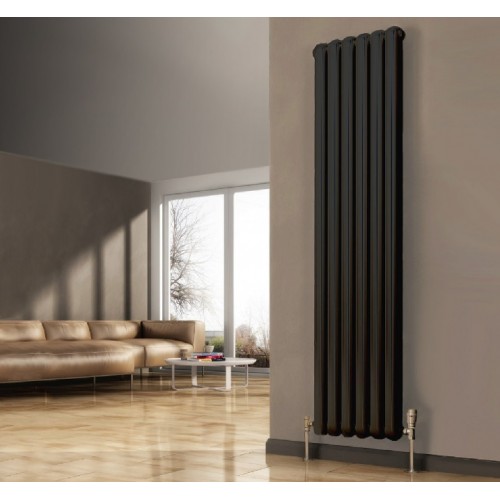
Showing 1 to 8 of 8 (1 Pages)
Frequently Asked Questions
How do I accurately calculate the pipe centres and total wall projection for the Reina Coneva Vertical Column Radiator given its specific 113mm depth to ensure it fits behind a door or in a narrow hallway
To solve the installation layout for the Reina Coneva, you must account for the radiator's fixed depth of 113mm. Technically, the pipe centres are calculated by taking half of this depth (56.5mm) and adding the required wall clearance (typically 50mm to allow for the brackets). This means your copper pipework should be roughed in at approximately 106.5mm to 110mm from the finished wall surface. This precise calculation prevents the radiator from protruding too far and obstructing door swings or walkway traffic in narrow corridors.
What are the thermodynamic advantages of the mild steel construction used in the Reina Coneva Vertical Radiator compared to traditional cast iron when heating a room rapidly
The Reina Coneva Vertical is manufactured from high-grade mild steel, which has a significantly lower thermal mass and higher thermal conductivity than cast iron. This technical property allows the radiator to heat up much faster when the central heating turns on, transferring energy to the room air via convection almost immediately. For homeowners who need responsive heating that solves the problem of coming home to a cold house, the Coneva offers a rapid warm-up time compared to the slow-response curve of heavier cast iron models.
Does the 10 Year Guarantee provided with the Reina Coneva Vertical Column Radiator cover corrosion that might occur if the system is not dosed with a chemical inhibitor
The 10 Year Guarantee provided by Reina and Budget Radiators covers manufacturing defects such as weld failures or material flaws. However, it is technically conditional on proper system maintenance. If the steel radiator corrodes from the inside out due to aggressive water chemistry or lack of inhibitor (like Fernox or Sentinel), this is considered installation error and is not covered. To solve this and protect your warranty, you must flush the system and add the correct concentration of inhibitor upon installation.
Why is the 1800mm x 510mm Reina Coneva model capable of producing a massive 6820 BTUs and is this sufficient for a large open plan living area
The 1800mm x 510mm model achieves a high output of 6820 BTUs (at Delta T 50
What type of radiator valves are technically required for the Reina Coneva Vertical Radiator if my pipework emerges from the wall rather than the floor
The Reina Coneva Vertical Radiator typically features bottom side connections. If your pipes are roughed in coming out of the wall, you should technically use Corner Valves rather than Angled Valves. Corner valves allow the valve head to point horizontally into the room or vertically (depending on orientation) while the connection turns 90 degrees back into the wall. This solves the aesthetic problem of having valve heads protruding awkwardly into the room and keeps the installation neat and flush against the wall.
How does the Delta T 50C rating affect the actual heat output of the Coneva Vertical Radiator if I am installing it on a modern low temperature system like a Heat Pump
The listed BTU outputs (e.g., 5518 BTUs for the 1500x440 model) are based on a Delta T of 50
Is it necessary to install a specific flow diverter or baffle inside the Reina Coneva Vertical Radiator to ensure the water reaches the top of the 1800mm columns
Most tall vertical radiators like the Reina Coneva are designed with internal flow baffles or require a specific flow and return configuration to force water to the top. It is technically critical to check the installation instructions for the "flow" side sticker. If you connect the flow pipe to the wrong side (the return side), the hot water may short-circuit across the bottom of the radiator, leaving the top 1.5 meters cold. Connecting it correctly solves the problem of cold spots and ensures even heat distribution up the full 1800mm height.
Can the Reina Coneva Vertical Column Radiator be installed on a plasterboard stud wall given the weight of the 7 section model when filled with water
The 1800mm x 510mm model is substantial steel unit and, when filled with water, imposes a significant shear load on the wall. While it is possible to install on stud walls, you cannot rely on plasterboard fixings alone. To solve the safety issue, you must technically locate the timber studs and anchor the brackets directly into them. If the studs do not align with the bracket positions, you must cut into the wall and install a timber noggin (horizontal brace) between studs to provide a solid fixing point for the heavy vertical radiator.
What is the difference between the Anthracite and White finishes on the Reina Coneva in terms of thermal emissivity and long term durability
Both the Anthracite and White finishes are applied using a high-quality powder coating process which is baked onto the steel, providing a durable, chip-resistant finish that withstands thermal cycling. Technically, darker colors like Anthracite have a marginally higher emissivity (ability to radiate heat) than white surfaces, but in real-world home heating, the difference is negligible. The choice should be aesthetic, as the powder coat on both efficiently seals the steel against external oxidation and solves the problem of paint peeling over time.
Why does the Reina Coneva Vertical Radiator sometimes trap air at the top and how do I technically resolve this to restore full heat output
Vertical radiators are prone to air locking because the top of the 1800mm column is often the highest point in that loop of the system. Air bubbles naturally rise and get trapped there, preventing hot water from circulating in the top rail. To solve this, you must turn off the heating pump (to stop aeration), wait for the system to cool slightly, and use the bleed key on the top vent of the Coneva. You may need to repeat this process several times over the first few weeks of operation to fully degas the large vertical volume.