
The Iris Products
Showing 1 to 7 of 7 (1 Pages)
Frequently Asked Questions
Why is the Iris available in both Grade 304 and Grade 316 stainless steel?
Standard Grade 304 stainless steel is highly durable and rust-resistant, making it perfect for standard residential bathrooms. However, for "aggressive" environments such as wet rooms, swimming pool areas, or coastal properties with high salt air content, Grade 316 (Marine Grade) is technically superior. Grade 316 contains molybdenum, which significantly increases corrosion resistance against chlorides and salts. You can often request a 316 upgrade for an additional cost to ensure longevity in these harsh conditions.
What are the pipe center measurements for the Iris?
The Iris uses side collector bars, so the pipe centers are calculated by subtracting the valve width from the total width. For both vertical and horizontal models, the pipe centers are approximately the Radiator Width minus 30mm. For example, on the 500mm wide vertical model, the pipe centers are 470mm. The wall-to-pipe center distance is adjustable between 75mm and 90mm, allowing flexibility for pipes coming from the floor or wall.
Can the Iris Horizontal model be used on a standard central heating system?
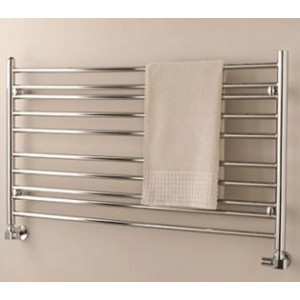
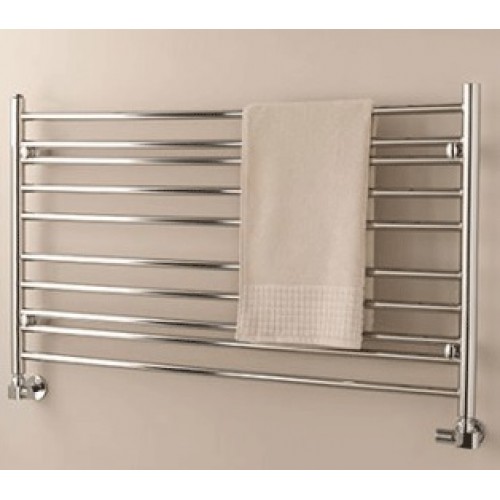
Yes, the Iris Horizontal is designed for standard hydronic (wet) central heating systems. It is particularly useful for placement above bathtubs or under windows where vertical wall space is limited. The horizontal orientation provides a long, heated rack for drying multiple towels side-by-side rather than stacking them, which can improve drying efficiency.
Is the Iris compatible with dual fuel installations?
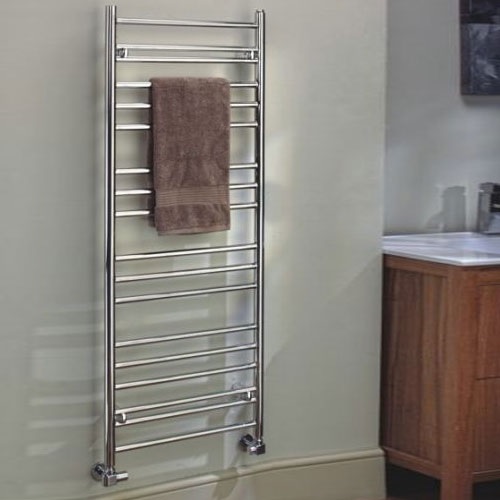
Yes, the Iris Vertical models are fully compatible with dual fuel kits. To achieve this, you need a T-piece and an electric heating element. However, the Iris Horizontal models are typically Central Heating Only because the horizontal tubes do not allow for the vertical insertion of a standard rigid heating element probe. If you require a horizontal electric rail, you would need a specialized fluid-filled factory option, which is not standard for this range.
Does the polished stainless steel finish reduce heat output?
Technically, polished surfaces have lower emissivity than painted surfaces (like white or anthracite), meaning they radiate less heat. However, the Iris compensates for this with its large 50mm square tube profile, which provides a significant surface area. For example, the 1200mm x 600mm vertical model outputs 1266 BTUs. While this is efficient for a stainless steel rail, it is lower than a painted steel panel radiator, so always check your room's heat loss requirements.
What type of valves do I need for the square tubes of the Iris?
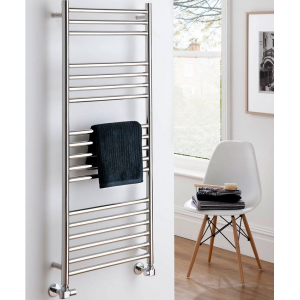
The Iris features square vertical collectors. While standard round valves will fit the 1/2" BSP connection, they can look visually jarring against the square profile. It is aesthetically recommended to use Square or Cube Valves to match the geometric design of the rail. If your pipes come from the wall, use Corner Valves; if from the floor, use Straight Valves.
How heavy is the Iris and what wall fixings are required?
Stainless steel is dense and heavy. The larger Iris models (e.g., 1200x600mm) are significant weight loads once filled with water. You must ensure the wall brackets are anchored into solid masonry or structural timber studs. Do not rely on plasterboard toggles alone. The rail comes with four robust brackets that are adjustable, allowing you to align the rail perfectly even on uneven tiled walls.
Does the Iris Horizontal vent air differently than the Vertical model?
Yes. In the Vertical model, air rises to the top collector where the bleed valve is located. In the Horizontal model, air can get trapped in the long horizontal top bar. The bleed valve is still located at the highest point, but you must ensure the rail is installed dead level or fractionally higher on the vent side to ensure all air pockets can be released, otherwise, you may get cold spots on the top bar.
How do I maintain the polished finish?
The Iris is not chrome plated; it is polished raw stainless steel. This means there is no plating to peel or flake off. To maintain the shine, simply clean with a soft microfiber cloth and warm soapy water or a dedicated stainless steel cleaner. If minor surface scratches occur over time, they can technically be polished out using a fine metal polish, which is impossible with chrome-plated rails.