
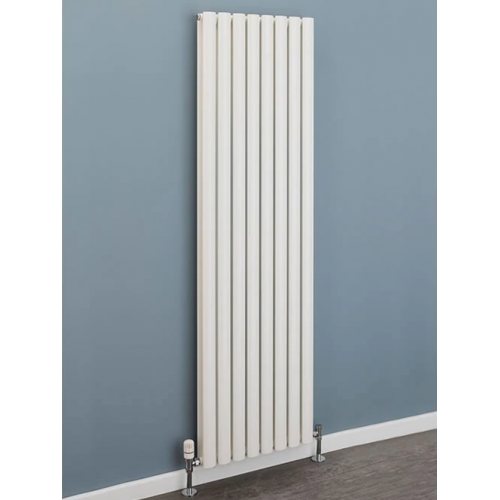
The Oval Double Vertical - Made to Order Products
Frequently Asked Questions
How does the double column configuration of the vertical Oval radiator technically impact the radiant vs convective heat ratio compared to a single panel model?
A double column vertical radiator has two rows of tubes. The front row emits radiant heat directly into the room, while the rear row heats the air trapped between the columns and the wall. This technically creates a powerful "chimney effect" (convection) that accelerates warm air upwards. Unlike a single panel which is largely radiant, the Double Oval relies heavily on this convection current to circulate heat, making it more effective at raising the ambient air temperature of large volume rooms with high ceilings.
Given the 120mm depth and the added weight of a double vertical radiator, what are the specific structural reinforcement requirements for installing this on a dry lined wall?
A water-filled double vertical radiator is extremely heavy (often exceeding 60kg). Standard plasterboard fixings will fail under this shear load. The technical solution is to use "noggins" (horizontal timber braces) installed between the studs behind the plasterboard at the exact height of the brackets. If the wall is already finished, you must use heavy-duty toggle anchors that expand behind the board, or preferably, anchor the brackets directly into the masonry blockwork using long frame fixings that bridge the gap between the plasterboard and the solid wall.
Does the massive internal volume of the Oval Double Vertical radiator require an additional expansion vessel if added to a sealed combi boiler system?
Yes, adding large volume radiators increases the total system water content. A standard combi boiler has an internal expansion vessel sized for a typical system (usually around 8-10 liters). If the total water volume expands beyond the vessel's capacity when hot, the pressure relief valve will discharge. To solve this, you must calculate the total system volume including the new radiator. If it exceeds the boiler's limit, a remote external expansion vessel must be installed on the return pipework to handle the excess thermal expansion safely.
How do I technically determine if the flow rate from my existing 15mm pipework is sufficient to supply a 10,000 BTU vertical radiator without hydraulic starvation?
A 10,000 BTU radiator requires a flow rate of approximately 290 kg/hr at a 15
What is the correct balancing procedure for a tall vertical radiator installed at the end of a heating circuit to ensure it heats up evenly from top to bottom?
Vertical radiators at the end of a run often suffer from low differential pressure. To solve this, you must perform a "full system balance." Close the lockshield valves on the radiators closest to the boiler (sometimes to just 1/4 turn open) to force water past them. Open the lockshield on the distant Oval Double Vertical fully. This artificially restricts the easy loops and forces the system pressure to push the hot water all the way to the end of the circuit and up the tall vertical columns.
What are the specific clearance requirements for the thermostatic valve heads when installing a 120mm deep radiator in a narrow corridor to avoid impact damage?
A 120mm deep radiator plus 20mm bracket space places the front face 140mm from the wall. Standard TRV heads protrude another ~80mm horizontally. In a narrow corridor, this 220mm total projection creates a trip hazard and risks shearing the valve off. The technical solution is to specify "non-intrusive" corner valves that orient the TRV head parallel to the radiator (pointing along the wall) rather than into the room. This keeps the valve gear within the 140mm "shadow" of the radiator, protecting it from impact.