
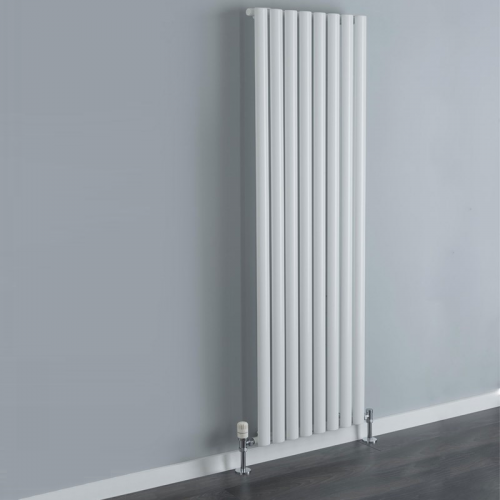
The Oval Single Vertical - Made to Order Products
Frequently Asked Questions
Does the elongated vertical height of the made to order Oval Single radiator require an internal flow diverter to prevent the hot water from short circuiting across the bottom?
Yes, specifically for tall vertical models over 1500mm, water naturally takes the path of least resistance across the bottom manifold. To solve this thermal distribution problem, these radiators often utilize an internal baffle or flow diverter. This component physically blocks the water from flowing directly to the outlet, forcing the pressure to push the hot water all the way up the vertical oval tubes to the top before it can return down, ensuring the entire surface area radiates heat evenly.
How should I account for manufacturing tolerances when roughing in pipework for a made to order radiator that has not yet arrived on site?
Steel radiators manufactured to custom specifications can have a linear tolerance variance of roughly 1mm to 2mm per section due to the welding and expansion process. To solve the problem of pipes not fitting, you should never drill your floor tiles based on the theoretical paper dimensions. The technical best practice is to have the plumber leave the copper pipe tails long and loose (unfixed) under the floorboards and only effect the final rigid connection once the radiator physically arrives and you can measure the exact center-to-center distance of the valve inlets.
When selecting a very narrow Oval Single Vertical model (e.g., 240mm width), how do I technically manage the installation of Thermostatic Radiator Valves (TRVs) without them protruding wider than the radiator itself?
On extremely narrow vertical radiators, standard angled TRVs pointing outwards can add 150mm to the total width, defeating the purpose of a space-saving design. To solve this spatial problem, you should use "Corner" valves (if pipes come from the wall) or "Straight" valves (if pipes come from the floor) and orient the valve heads to point underneath the radiator or parallel to the wall. This keeps the valve hardware within the shadow of the radiator's vertical footprint.
Why is the Oval Single Vertical profile technically superior to the Double version for installations located directly behind opening doors?
The critical technical specification here is wall projection. The Single Oval model has a depth of 95mm, whereas the Double is approximately 120mm-130mm installed. In a standard hallway, a door handle typically sits 100mm-120mm from the wall face when fully open. Installing the Single Oval ensures the door can open fully (90 degrees) without the handle impacting the radiator surface, preventing mechanical damage to the powder coat finish and the door hardware.
How does the low water content of the single column design technically affect the boiler cycling and system response time compared to cast iron?
The single row of oval tubes holds significantly less fluid volume than a multi-column cast iron radiator. This reduces the thermal inertia of the emitter. Technically, this solves the problem of "overshoot" where a room continues to heat up after the thermostat clicks off. The Oval Single heats up rapidly when demand is signaled and cools down quickly when demand ceases, making it the most energy-efficient choice for modern systems that rely on precise time and temperature control.
For made to order custom colors, how does the electrostatic powder coating process technically compare to standard wet spray paint in terms of thermal durability?
The made to order RAL finishes are applied using a dry electrostatic powder that is baked in a curing oven at roughly 200 degrees Celsius. This causes the powder to melt and fuse into a cross-linked polymer chain. This is technically superior to wet paint because it does not rely on solvents to dry. The result is a finish that is thermally stable and will not emit volatile organic compounds (fumes) or soften when the radiator heats up to its maximum operating temperature of 75 degrees Celsius.
If I order a custom height that is not listed in the standard BTU table, how do I accurately calculate the thermal output to ensure the room is adequately heated?
Heat output is linearly related to surface area. To solve the sizing problem for a custom height, you can calculate the BTU per section. Take a standard stocked size with the same height (or closest height) and divide its total BTU by the number of sections to get the "heat output per oval tube." Multiply this figure by the number of sections you plan to order. For exact non-standard heights, you must extrapolate the value based on the surface area difference, or contact the technical team for the precise Delta T 50 rating of your custom dimensions.
Do the vertical convection channels of the Oval Single radiator require specific maintenance to prevent dust accumulation from acting as a thermal insulator?
Yes, the gaps between the oval tubes act as chimneys that accelerate air movement. Over time, this draws dust into the crevices. Thick dust layers act as insulation, technically reducing the convective heat transfer coefficient. To solve this, you should use a long, flexible radiator brush to clean between the columns annually. Unlike double panel radiators with hidden fins that are impossible to reach, the open single-column design allows for full access to maintain maximum thermal efficiency.
From a hydraulic balancing perspective, does a tall single column radiator create a higher pressure drop than a short wide radiator of the same BTU output?
Yes, pushing water up a vertical column of 1800mm creates more hydrostatic head resistance and friction loss than flowing through a short horizontal manifold. If you have a system with both tall vertical radiators and short horizontal ones, the water will naturally flow to the short ones first. To solve this hydraulic imbalance, you must restrict the lockshield valves on the short radiators significantly to force the system pressure to push the water up the tall Oval Single columns ensuring they get hot from top to bottom.
Why is the Oval Single Vertical radiator technically recommended for 'floating' or suspended floors where weight load is a critical concern?
A single column radiator filled with water weighs approximately 50 percent less than its double column equivalent. On suspended timber floors or older properties where joist integrity is a concern, minimizing the static dead load is critical. By choosing the Single Oval Made to Order, you achieve the necessary vertical heating surface area while keeping the total mass (steel plus water) within safe structural limits for wall-hung installation, reducing the shear force on the wall brackets.