
The Square Products
Showing 1 to 1 of 1 (1 Pages)
Frequently Asked Questions
How does the shelf design of the Reina Troisi technically improve towel drying efficiency compared to standard vertical ladders?
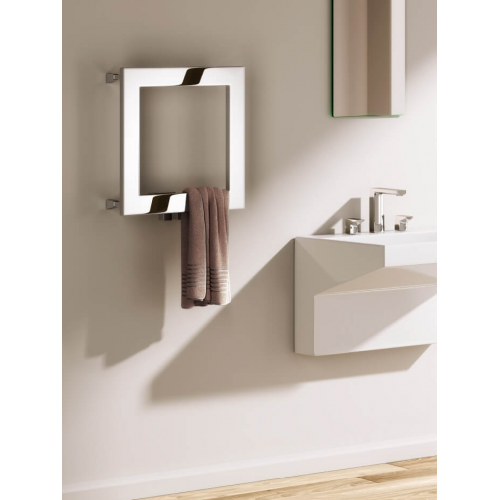
The Reina Troisi features a cantilevered heated shelf structure with a depth of 300mm, unlike standard vertical ladders that only provide hanging bars. This technical configuration solves the problem of limited storage by allowing you to stack folded towels on the top shelf while hanging damp ones on the lower bar. Heat rises naturally through convection, so the towels stacked on the shelf absorb the rising thermal energy that would otherwise escape to the ceiling, ensuring deep warmth penetration into thick bath sheets and maximizing energy utilization.
Why is the 304 Grade Stainless Steel construction of the Troisi superior to chrome plating for wet room installations?
The Troisi is manufactured from high grade 304 Stainless Steel, which is an alloy containing chromium and nickel. Unlike chrome plated mild steel where the finish is a thin surface layer that can peel or rust if scratched, stainless steel forms a passive oxide layer that self repairs when exposed to oxygen. This technical characteristic makes the Troisi immune to the galvanic corrosion and rusting issues frequently found in high humidity wet rooms, providing a permanent solution for durability in damp environments.
Can the Reina Troisi be converted into a dual fuel unit for summer heating when the boiler is off?
Yes, the Reina Troisi is fully compatible with dual fuel modification. To solve the problem of cold towels in summer, you can install a T Piece on the return inlet. This allows you to insert an electrical heating element into the vertical collector while maintaining the connection to your central heating pipes. You must ensure the element wattage is compatible with the 208 Watt output of the rail to prevent overheating, and this setup allows independent operation via the electric element when your central heating is shut down.
What are the specific wall installation requirements to support the 300mm depth of the Troisi shelf?
The Troisi extends 300mm from the wall, creating a significant leverage force when fully loaded with wet towels. Technically, this requires a robust fixing surface. You cannot install this rail using standard plugs on a drywall or plasterboard surface alone. To solve the stability problem, you must locate the timber studs behind the plasterboard or use heavy duty toggle bolts or chemical anchors if fixing to masonry. Ensuring the brackets are anchored into a solid structural element is critical to prevent the rail from pulling away from the wall over time.
How do I calculate if the 708 BTU output of the Troisi is sufficient to heat my bathroom air?
You must strictly separate towel warming from room heating. The Troisi delivers 708 BTUs at Delta T50. To solve the sizing problem, measure your bathroom Height, Width, and Length in meters and use the Budget Radiators BTU calculator to find your room heat loss. If your room requires 2000 BTUs, the Troisi alone will not be enough to heat the air; it will only warm the towels. In this technical scenario, you should use the Troisi as a secondary heat source alongside underfloor heating or a separate panel radiator to maintain a comfortable ambient temperature.
What type of valves are required to connect the Reina Troisi to standard 15mm copper pipework?
The Troisi uses standard 1/2 inch BSP female connections located at the bottom of the vertical uprights. To ensure correct flow dynamics, the valve choice depends on your pipe work. If your pipes emerge from the wall, you require Angled Valves to join the pipe to the vertical inlet without messy bends. If your pipes come up from the floor, you can use Angled valves (if the pipes are positioned wide enough) or Straight valves. Correct valve selection prevents stress on the joints and ensures a water tight seal on the stainless steel threads.
How does the polished finish of the Reina Troisi affect its thermal emissivity compared to painted rails?
Technically, polished stainless steel has a lower emissivity than painted surfaces (like white or black), meaning it radiates heat less aggressively into the room air. However, the Troisi solves this by using the highly conductive nature of steel to transfer heat directly to the towels touching the bars. While it may take slightly longer to raise the air temperature of a cold room compared to a painted radiator, the direct contact heat transfer is highly efficient for drying fabrics, making it an optimized solution for towel warming rather than space heating.
What maintenance is required to preserve the 10 Year Guarantee on the stainless steel surface?
The 10 Year Guarantee covers material failure and leaking welds, but you must maintain the surface to prevent cosmetic issues. Although stainless steel is corrosion resistant, it can accumulate mineral deposits or chemical residue from bathroom cleaners. To solve this, you should wipe the rail with a microfiber cloth and warm soapy water or a dedicated stainless steel cleaner. You must strictly avoid using steel wool or chloride based bleaches, as these can disrupt the protective oxide layer and cause superficial staining known as tea staining.
Does the Troisi require a specific system inhibitor to prevent internal corrosion?
Yes, even though the Troisi is stainless steel, your central heating system likely contains other metals like copper pipes, brass valves, and a steel or aluminium boiler heat exchanger. Mixing metals can cause galvanic corrosion. To technically solve this, you must add a high quality chemical inhibitor to the system water after installation. This fluid balances the PH levels and creates a protective film inside the system components, preventing the stainless steel rail from reacting with other metals and ensuring the longevity of the entire heating loop.