
The Burton Products
Showing 1 to 1 of 1 (1 Pages)
Frequently Asked Questions
How does the high BTU output of The Burton affect bathroom heating compared to standard ladder rails?
The Burton delivers a substantial heat output of 3334 BTUs at Delta T50 which is significantly higher than many standard ladder rails of similar dimensions. This high output allows the unit to function as a primary heat source for many medium-sized bathrooms rather than just a towel warmer. When calculating your heating requirements using a BTU calculator you will likely find that this single vertical column radiator can replace an existing panel radiator and towel rail combination saving wall space while maintaining an optimal ambient temperature of 21
What specific technical steps are required to install The Burton as a dual fuel system?
To configure The Burton for dual fuel operation you must integrate a T-piece into the inlet piping to accommodate both the central heating valve and an electric heating element. Given the high output of 978 Watts you need to select a heating element that matches this wattage safely usually rated around 600W to 800W for thermostatic control to prevent overheating. The electric connection must be fused via a switched spur outside the bathroom zones and the entire assembly must be water-tight to handle the pressure fluctuations of the central heating system.
How does the 116mm depth of The Burton influence installation planning in compact spaces?
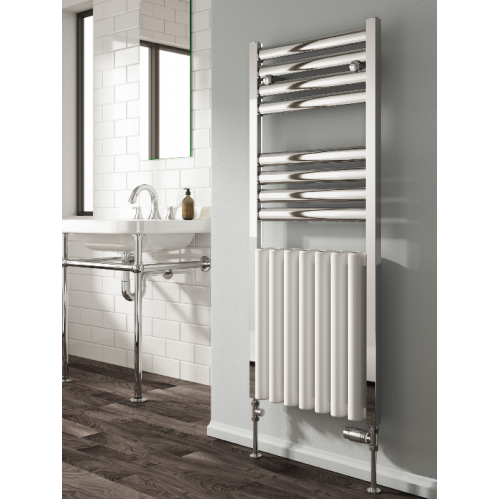
The Burton has a depth of 116mm which is deeper than flat panel rails due to its robust column structure. When planning installation in a narrow corridor or behind a door you must account for this projection plus the valve clearance. You should measure the swing radius of any adjacent doors and the proximity of sanitary ware like basins or toilets. This depth is beneficial for heat convection as it allows greater airflow around the 8 sections but requires sturdy wall fixings capable of supporting the leverage exerted by the fully filled unit.
What are the valve connection requirements for The Burton considering its column design?
The Burton typically utilizes standard 1/2 inch BSP connections found on most UK radiators. However due to its column configuration you need to determine if your pipework feeds from the floor or the wall. For floor-fed pipes you will require straight radiator valves to connect vertically into the bottom inlets. For wall-fed pipes you will need angled or corner valves. Accurate measurement of pipe centers is critical before tiling as the rigid steel construction does not allow for the flexibility found in copper pipework adjustments.
How does the chrome finish on The Burton impact the thermal emission rate?
While chrome finishes technically have a lower emissivity value than painted surfaces The Burton compensates for this through its large surface area provided by the 8-section column design. The rated output of 3334 BTUs takes the chrome finish into account so you do not need to derate the output calculation manually. The high quality plating is designed to be conductive and durable ensuring that the radiator reaches operating temperature quickly and sustains heat transfer effectively for towel drying.
Can The Burton be mounted on partition walls or does it require solid masonry?
Due to the weight of the steel construction and the water volume held within the 8 sections The Burton imposes a significant load on wall fixings. While solid masonry is the preferred substrate for installation you can mount it on plasterboard partition walls if you reinforce the structure. You should use noggins or timber battens installed between the studs behind the plasterboard to anchor the brackets securely. Using standard plasterboard toggles alone is not recommended for a radiator of this weight and projection.
What does the 10 Year Guarantee cover in terms of technical failures?
The 10 Year Guarantee provided by Budget Radiators covers the structural integrity of the steel welding and the quality of the chrome plating against manufacturing defects. This includes protection against leaks resulting from weld failures and flaking or pitting of the chrome finish under normal usage. It technically excludes issues arising from improper installation such as over-tightening valves or corrosion caused by a lack of chemical inhibitor in the central heating system water.
How does the vertical column orientation improve drying efficiency for multiple towels?
The vertical column design of The Burton combined with integrated horizontal bars creates a chimney effect for air movement. As air is heated by the vertical columns it rises drawing cooler air in from the bottom which circulates through the towels hanging on the bars. This convection current ensures that towels dry more evenly and faster than on flat panel rails where air can become trapped. The spacing of the bars allows for thick towels to be draped without blocking the convective heat flow completely.
Is The Burton compatible with microbore pipework systems common in modern builds?
The Burton is compatible with microbore systems typically 8mm or 10mm pipework but you will need specific reducers or microbore valves to bridge the connection to the standard 1/2 inch inlets. A potential technical issue with microbore is the reduced flow rate which might struggle to supply the volume of hot water needed for a high output radiator like The Burton (3334 BTUs). You should ensure your system pump has sufficient head pressure to maintain adequate flow velocity through the narrower pipes to prevent cold spots on the radiator.