
The Glora Products
Showing 1 to 6 of 6 (1 Pages)
Frequently Asked Questions
How does the significant 170mm depth of The Glora affect installation planning in small bathrooms?
The Glora features a substantial projection of 170mm from the wall which is significantly deeper than standard ladder rails (typically 80mm to 100mm). This deep profile creates a bold visual statement but technically requires careful spatial planning. You must measure the swing radius of any adjacent doors and the proximity of vanity units to ensure they do not strike the radiator. In narrow corridors or cloakrooms this extra depth might obstruct walkways so we recommend installing The Glora on a feature wall where the projection will not impede movement.
Why is there such a large heat output difference between The Glora Chrome and The Glora Anthracite models?
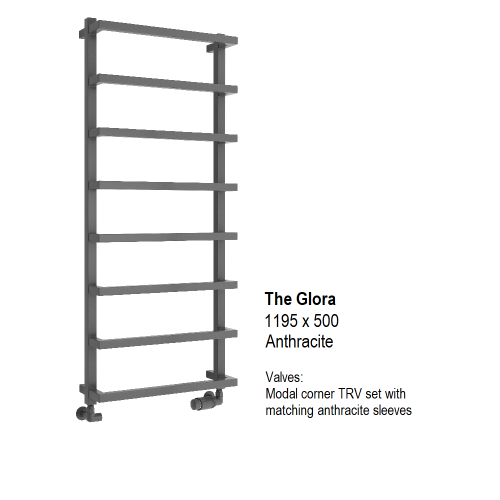
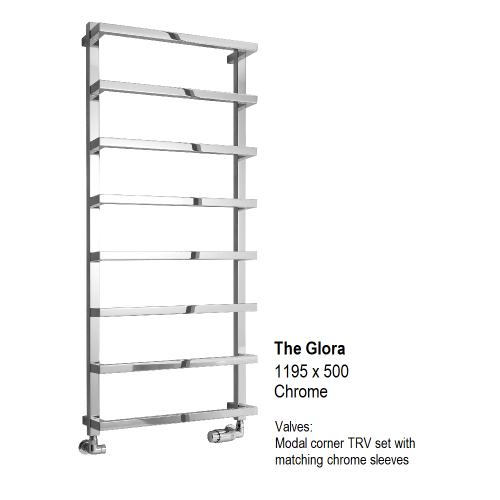
The finish of The Glora dramatically impacts its thermal efficiency. For example the 1195mm Anthracite model outputs 1804 BTUs while the Chrome version of the same size outputs only 1169 BTUs. Chrome plating acts as a thermal insulator that traps heat within the steel body reducing radiant emission. To solve this heating deficit in a cold bathroom you should prioritize the Anthracite finish for maximum warmth or ensure you strictly calculate your room BTU requirements and potentially oversize the Chrome model to compensate for the lower output.
What specific wall fixings are required to support The Glora given its depth and water weight?
Due to the 170mm cantilevered depth The Glora exerts more leverage force on the wall brackets than a flat rail especially when filled with water and wet towels. To solve the problem of sagging or loose fixings you must not rely on standard plasterboard plugs. We technically recommend anchoring the brackets directly into timber studs or masonry. If installing on a stud wall where studs do not align with the bracket positions you should install a timber noggin or plywood reinforcement behind the plasterboard to provide a secure biting point for the screws.
Can The Glora be converted to a dual fuel system for summer towel drying?
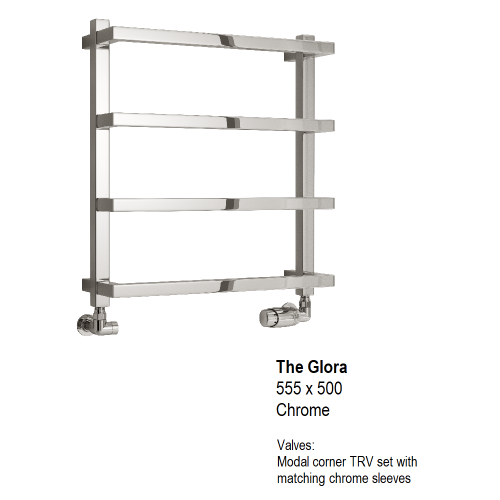
Yes The Glora is compatible with dual fuel conversion which solves the problem of damp towels during summer when the central heating is off. You technically need to install a T-piece at the inlet which allows both the radiator valve and an electric heating element to enter the unit. You must select an element wattage that is safe for the specific size of the rail (e.g. 150W for the small 555mm Chrome model or 400W for the large Anthracite model) to prevent internal pressure buildup from overheating the fluid.
How do the section counts of 4, 6, and 8 affect the drying capacity of The Glora?
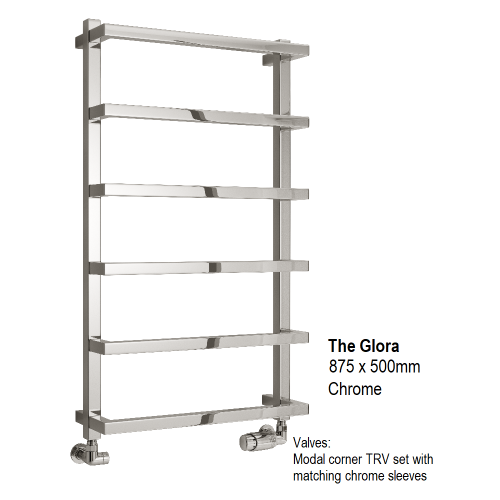
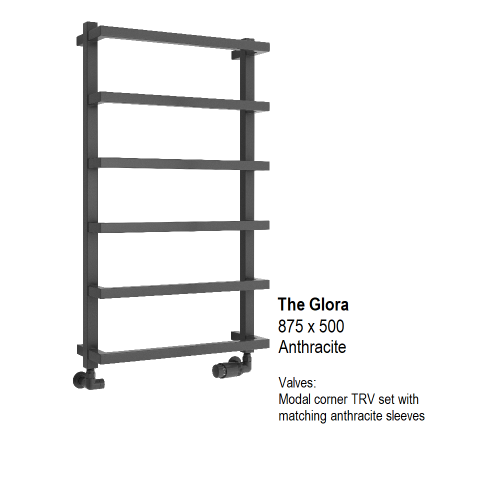
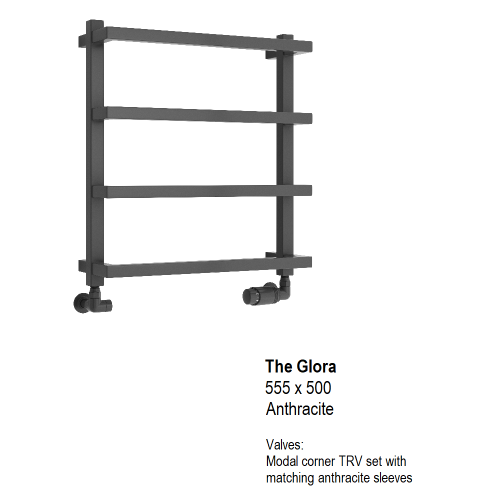
The Glora is available in three heights with varying section counts: 555mm (4 sections), 875mm (6 sections), and 1195mm (8 sections). From a problem solving perspective if you have a large family you should opt for the 1195mm model. The generous spacing between the 8 horizontal tube sections allows for thicker towels to be hung easily without bunching up which promotes better air circulation and faster drying compared to rails with tightly packed bars.
What type of valves are needed for The Glora if my pipework emerges from the floor?
The Glora features standard 1/2 inch BSP inlet connections located at the bottom of the vertical uprights. If your pipes emerge from the floor you will technically require Straight Radiator Valves to connect vertically. Using Angled valves would force the valve heads to point outwards or sideways which can look untidy and increase the already significant 170mm footprint. Straight valves ensure the pipework rises cleanly from the floor directly into the manifold keeping the installation neat and compact.
How do I bleed trapped air from The Glora to fix cold spots on the top bar?
Cold spots at the top of The Glora indicate that air is trapped inside the vertical headers preventing hot water circulation. To fix this technical issue turn off your heating pump and locate the bleed valve at the top of the rail. Use a radiator bleed key to crack the valve open slightly. Wait for the hissing sound of escaping air to stop and for a steady trickle of water to appear before closing it tightly. This restores full internal pressure and ensures the entire surface area heats up effectively.
Does the 10 Year Guarantee cover corrosion on the Anthracite finish in wet zones?
The 10 Year Guarantee covers manufacturing defects including weld integrity and finish adhesion. However The Glora is made of mild steel so installing it in a direct wet zone (like inside a shower enclosure) can technically void the warranty if the finish is damaged by constant water exposure. To solve the problem of potential rust you should install the rail in Zone 2 or Zone 3 of the bathroom where it is safe from direct sprays ensuring the Anthracite powder coating remains intact and protective.
What are the pipe center measurements for The Glora 500mm wide model?
For the 500mm wide Glora the pipe centers are approximately 455mm to 460mm depending on the valves used. You must never rough-in your pipework at exactly 500mm centers as this is the external width of the unit. To solve the problem of misaligned pipes which can ruin tiled floors we strictly advise having the radiator and valves physically on site to measure the exact distance between the valve inlets before committing to the final plumbing position.
Is The Glora suitable for use with a low temperature heat pump system?
The heat outputs listed for The Glora (e.g. 1804 BTUs for the large Anthracite model) are calculated at Delta T50 standard boiler temperatures. If you use a heat pump running at Delta T30 the effective output will drop by roughly 50 percent. To solve this sizing issue on a renewable system you must use the Anthracite model for its superior conductivity and likely specify the largest 1195mm size to ensure you generate enough radiant heat to warm the bathroom effectively without a secondary heat source.