
The Ticino Products
Showing 1 to 2 of 2 (1 Pages)
Frequently Asked Questions
Why is the BTU output for The Ticino Chrome model significantly lower than the Anthracite version?
The heating difference is caused by the surface finishing process. Chrome plating acts as a thermal insulator, trapping heat within the mild steel body and reducing the radiative efficiency by approximately 35-40%. Specifically, The Ticino Chrome outputs just 392 BTUs (115 Watts) at ?t50
What are the precise pipe centres for first-fix plumbing on The Ticino 450mm x 500mm?
Unlike standard ladders where pipe centres often match the width, The Ticino has specific connection points. The pipe centres are 460mm (centre-to-centre). When roughing in pipework before tiling, you must also account for the valves. Adding standard manual or thermostatic valves typically adds 80-90mm to the width, meaning your pipes should likely be set around 540mm-550mm apart. Always have the physical valves on-site to measure the exact allowance before finalizing copper pipe positions.
How does the deep wall projection of The Ticino affect installation behind doors?
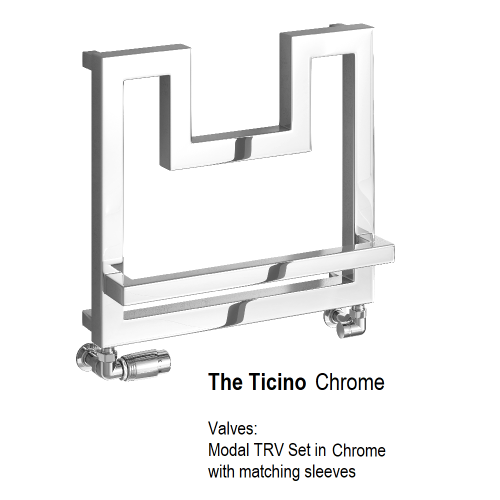
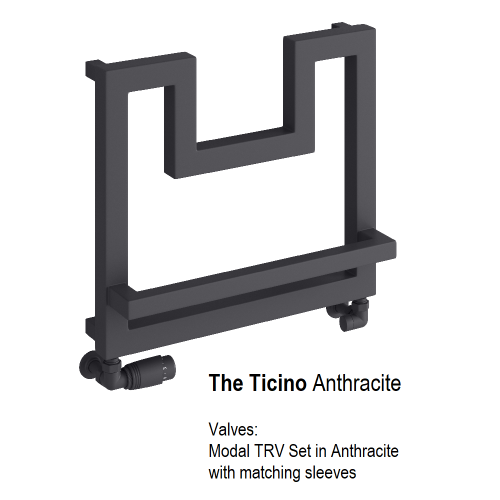
The Ticino has a distinctive looped "bunny" design which creates a significant depth. The wall-to-front distance is between 162mm and 177mm. This is nearly double the depth of a standard flat ladder rail (usually ~80-100mm). Before installation, you must verify that this 177mm projection does not obstruct the swing radius of shower doors, vanity cabinet drawers, or the main bathroom door. It requires a clear "traffic" zone to avoid being a hazard.
Can The Ticino be converted to Dual Fuel and what element wattage is safe?
Yes, The Ticino is manufactured from Mild Steel and is suitable for Dual Fuel. However, due to its compact liquid volume and low surface area, you must be careful not to overpower it. Since the Chrome model only dissipates 115 Watts, installing a high-output element (like 300W or 600W) could cause dangerous internal pressure or surface overheating. A 100W or 150W electric element is technically recommended to match the rail
What type of valves should I use considering the bottom connections and wall projection?
The Ticino features bottom vertical inlets. Because the rail projects roughly 170mm from the wall, your choice of valve depends on your pipework. If pipes come from the floor, use Straight Valves. If pipes come from the wall, Angled Valves or Corner Valves are required. Given the rail's depth, Corner Valves are often the best problem-solving solution as they orient the improved thermostatic head horizontally, preventing it from protruding further into the room and creating a trip hazard.
How does the 10-Year Guarantee apply if I install The Ticino on an open circuit system?
The 10-Year Guarantee provided by Budget Radiators covers manufacturing defects on closed central heating systems only. If you install this Mild Steel rail on an "open circuit" (often found in older domestic hot water systems where water is drawn from the tap), oxygenated water will cause rapid internal corrosion, which is not covered. Ensure your installer confirms you have a closed-loop system and adds a chemical inhibitor (like Fernox F1) to protect the steel and validate the warranty.
Does the unique shape of The Ticino trap air, and how do I bleed it effectively?
The looped design can create air pockets at the upper curves of the rail. If the top of the loops feels cold while the bottom is hot, air is trapped, preventing the full ?t50
Can I install The Ticino on a partition wall given its 170mm depth and leverage?
While The Ticino itself is compact, the 170mm projection creates a "cantilever" effect that puts extra tensile stress on the top wall fixings. If installing on a plasterboard (stud) wall, you cannot rely on standard rawl plugs. You must locate the wooden studs for the brackets or use specialist heavy-duty toggle anchors (like Geofix or GripIt). Ideally, have your installer fit a timber noggin behind the plasterboard at the bracket height (approx 350-400mm spacing) to ensure a rigid fix that won't pull away over time.