
Todi - Chrome Products
Showing 1 to 6 of 6 (1 Pages)
Frequently Asked Questions
Why is the heat output of the Todi Chrome towel rail technically lower than the black version of the same size?
The chrome finish on the Todi acts as a thermal insulator. While the mild steel core heats up efficiently, the chrome plating has a lower emissivity rate than powder-coated finishes (like black or white), meaning it radiates less heat into the room. For example, the 1200mm x 108mm Todi Chrome outputs 413 BTUs compared to 668 BTUs for the black version. To solve this, always calculate your room's BTU requirement carefully and consider sizing up if you are set on the chrome aesthetic for a colder room.
What is the most effective technical solution for heating a narrow bathroom wall using the Todi Chrome range?
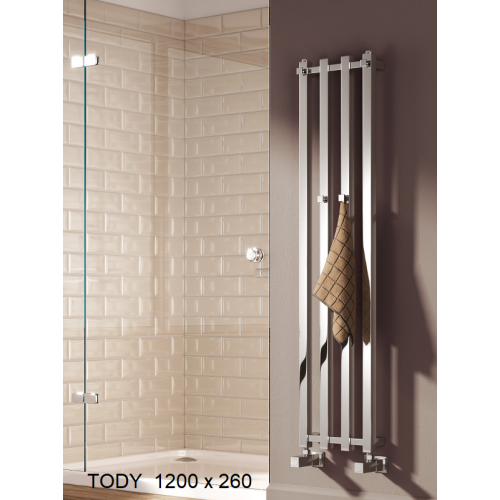
The Todi Chrome range offers a specific ultra-slim model with a width of just 108mm. This unit features two vertical collectors and is designed to fit in restricted spaces, such as next to a washbasin or behind a door where standard 400mm or 500mm wide rails are impossible to install. By utilizing vertical height (up to 1200mm), it provides a practical towel-drying solution without obstructing the floor plan or requiring major pipework relocation in tight en-suites.
How do I correctly install the Todi Chrome towel rail for dual fuel operation?
To configure the Todi Chrome for dual fuel (allowing summer use when the boiler is off), you must install a "T-piece" connector on one of the bottom inlets. The electric heating element slides through this T-piece into the vertical collector, while the central heating valve connects to the side of the T-piece. You technically need to ensure the element's wattage does not exceed the liquid capacity of the rail to prevent overheating, and always use a qualified electrician to fuse the element to a switched spur.
Does the chrome plating on the Todi rail require specific maintenance to prevent corrosion in humid environments?
Yes, although the Todi features high-quality chrome plating, maintenance is vital. Technically, chrome is a porous metal layer. To prevent "tea-staining" or rust spots in high-humidity zones, you should wipe the rail down regularly with a soft cloth and warm soapy water to remove condensation and dust. Never use abrasive scourers or acidic cleaners (like bleach-based sprays), as these chemically attack the chrome seal, leading to pitting and eventual failure of the mild steel core underneath.
What are the exact valve requirements for the bottom-entry connections on the Todi Chrome radiator?
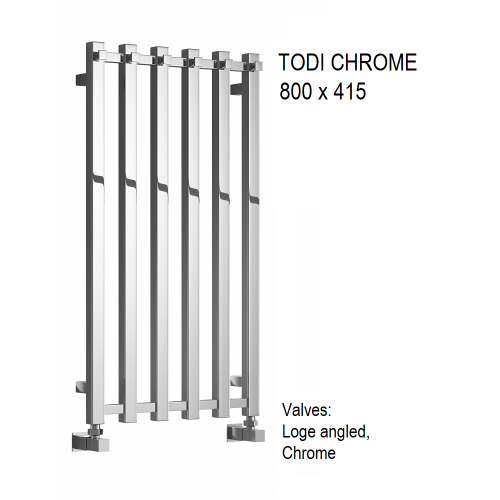
The Todi Chrome uses standard 1/2 inch BSP female connections located at the bottom of the vertical bars. The technical choice of valve depends on your pipework: use Angled Valves if your pipes emerge from the wall to create a neat 90-degree turn into the rail. Use Straight Valves if your pipes come vertically up from the floor. Incorrect valve choice will result in messy pipework geometry that places stress on the joints, potentially causing leaks over time.
Can the Todi Chrome be used as the primary heat source for a large family bathroom?
Technically, this depends on the room's heat loss calculation. Chrome rails are generally less efficient at heating air volume than radiators. For a large bathroom, a single Todi Chrome (even the largest 1200mm x 415mm model at ~1279 BTUs) might be insufficient as a standalone heater. The solution is often to use the Todi Chrome primarily for drying towels and pair it with a secondary heat source, such as underfloor heating or a standard panel radiator, to maintain the ambient room temperature.
What technical guarantee covers the Todi Chrome against manufacturing defects like flaking or leaks?
The Todi Chrome is covered by a 10 Year Manufacturer Guarantee. This warranty covers technical failures such as pinhole leaks in the welds or flaking of the chrome plating under normal usage conditions. It verifies that the product is manufactured to BS EN 442 standards, ensuring it has been pressure-tested (usually to 10 bar) to withstand standard central heating operating pressures (approx 1.5 - 2.5 bar) without structural failure.
Is it possible to install the Todi Chrome towel rail on a plasterboard wall?
Yes, but you must ensure technical structural support. The Todi is made of mild steel and, when filled with water, becomes significantly heavier (e.g., the 1200mm x 415mm model weighs over 10kg plus water weight). Standard plasterboard fixings are likely to fail. The solution is to fix the brackets directly into the wooden studs behind the plasterboard or use specialized heavy-duty hollow wall anchors (like Geofix or Molly bolts) to distribute the load safely and prevent the rail from pulling away from the wall.
How do I bleed the Todi Chrome radiator to resolve cold spots at the top of the vertical bars?
If the top of your Todi Chrome rail is cold, air is trapped inside the vertical collectors. To fix this technically: switch off your heating pump to stop circulation. Locate the bleed screw at the very top of the rail. Use a radiator bleed key to turn the screw anti-clockwise until you hear air hissing. Wait until water begins to trickle out steadily, then re-tighten. This displaces the air pocket with hot water, restoring full thermal efficiency to the upper sections of the rail.