
The Cleves Products
Showing 1 to 3 of 3 (1 Pages)
Frequently Asked Questions
How does the column design of the S4H Cleves technically improve heat output compared to standard ladder rails?
The S4H Cleves incorporates a central column radiator insert within the traditional frame. This design significantly increases the surface area available for heat transfer compared to a standard hollow tube ladder rail. For instance, the 1548mm high model generates 1058 BTU because the multiple column sections hold a larger volume of hot water and radiate heat outwards into the room, rather than just warming the towels hanging on the outer bars. This makes it a more effective solution for bathrooms that lack a primary heat source.
What are the critical installation differences between the wall mounted and floor mounted Cleves models?
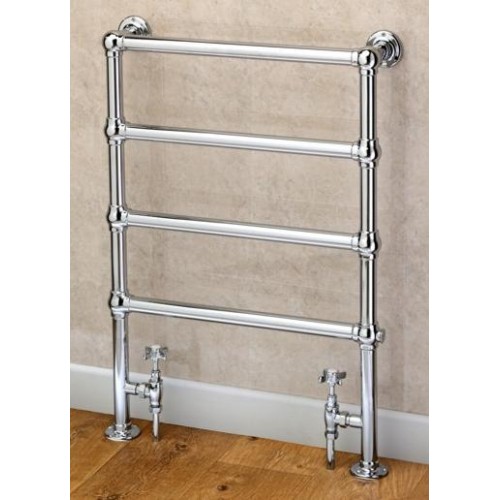
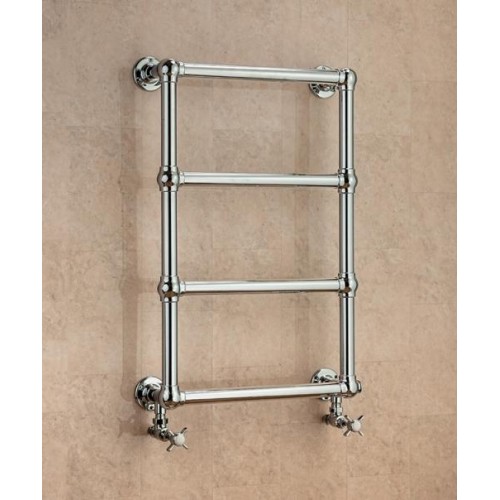
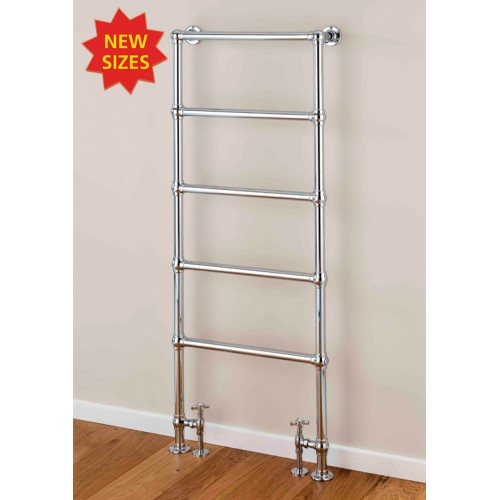
The installation requirements differ significantly between the two styles. The Wall Mounted Cleves (750 x 500mm) relies entirely on heavy duty wall anchors and requires a solid masonry wall or reinforced timber studs to support its full wet weight. In contrast, the Floor Mounted Cleves (848mm or 1548mm high) transfers the majority of its weight directly to the floor through its feet. For the floor mounted version, you must ensure your subfloor is secure enough to screw the flange bases down, while the wall stays serve primarily to stabilize the unit against tipping rather than bearing the load.
How do I accurately calculate the pipe centres for the floor mounted Cleves unit?
To prepare your pipework before the product arrives, you need to calculate the pipe centres based on the unit width and valve type. For the floor mounted Cleves which is 598mm wide, the pipe connections are typically on the side of the vertical uprights or the bottom knuckle joints. If using standard Angled valves, you generally add approximately 80mm to 90mm to the total width. This means your pipes should be roughly 680mm to 690mm apart. However, it is technically safest to have the physical unit on site to measure the exact thread-to-thread distance before drilling through expensive floor tiles.
Can the S4H Cleves be installed as a dual fuel system for summer heating?
Yes, the S4H Cleves is fully compatible with dual fuel installation. This setup allows you to heat the rail via your central heating boiler in winter and use an electric element in summer. To achieve this, you must install a T-Piece on one of the bottom inlets. This T-Piece allows both the radiator valve and the electric element to enter the same port. You must ensure the element wattage (e.g., 150W or 300W) is appropriate for the internal liquid volume of the specific Cleves model you choose to prevent boiling or over-pressurization.
What type of radiator valves are technically required for the floor mounted S4H Cleves?
For the Floor Mounted Cleves, the connection ports are located at the bottom of the vertical legs, facing outwards or downwards depending on the specific casting. If your pipes come up from the floor, you will technically require Angled Radiator Valves. These allow the vertical pipe to connect 90 degrees into the horizontal port of the radiator. If you were to use Straight valves, your pipes would need to run horizontally along the floor surface, which is rarely done in bathrooms for aesthetic and cleaning reasons.
Is the mild steel construction of the Cleves suitable for open vented gravity systems?
Yes, the S4H Cleves is manufactured from high quality mild steel, which is chemically stable in both open vented (gravity fed) and closed (pressurized) central heating systems. Unlike aluminum radiators which can corrode in open systems due to oxygenation, mild steel is robust. However, you must ensure that a high quality corrosion inhibitor is added to the system water. This chemical protection is a technical requirement to prevent internal rusting and sludge buildup, which ensures the 10 Year Guarantee remains valid.
How do I verify if the 1058 BTU output is sufficient for my specific bathroom size?
To determine if the largest Cleves model (1058 BTU) is enough, you must calculate your room's heat loss. Measure the Height, Length, and Width of your bathroom in meters to get the volume, then multiply this by a factor of 150 (for bathrooms). If the result is lower than 1058, this single rail is sufficient. If your room requires more heat (e.g., 2000 BTU), the Cleves should be treated as a secondary heat source or towel warmer, and you will need to install an additional radiator to maintain a comfortable ambient temperature.
What is the procedure for bleeding air from the Cleves to fix cold spots?
If you notice the top bar or the upper columns of your Cleves are cold while the bottom is hot, you have an air lock. To fix this technically, turn off your central heating pump to stop the circulation. Locate the bleed screw, which is typically found on the top rear of the vertical uprights. Use a square radiator key to slightly open the screw until the hissing air stops and a steady stream of water flows out. Close it immediately. This process ensures the internal chambers are 100% water filled for maximum thermal efficiency.
Why is the wall projection depth different for the floor mounted versus wall mounted models?
The wall projection depth varies because of the mounting mechanism. The Wall Mounted Cleves has a depth of 125mm, determined solely by the length of the wall brackets. The Floor Mounted Cleves has a depth of 137mm to 144mm because the feet determine the distance from the skirting board. You must account for this deeper projection when planning the layout, especially if installing near a toilet or vanity unit, to ensure there is adequate clearance for movement and that the rail does not protrude into the walkway.
Can I convert the S4H Cleves to a purely electric operation if I have no plumbing?
Yes, the S4H Cleves can be converted to a purely electric towel rail. This involves filling the unit with a thermodynamic liquid (usually water with a glycol inhibitor to prevent freezing and corrosion) to approximately 90% capacity to allow for expansion. You then insert an electric heating element into one side and seal the other side with a blanking plug. This installation must be carried out by a qualified electrician to ensure the element is properly fused and that the unit is safe for use in a bathroom Zone 2 or Zone 3 area.