
The Eltham Products
Showing 1 to 1 of 1 (1 Pages)
Frequently Asked Questions
Why is the BTU output (689 BTUs) lower than standard panel radiators?
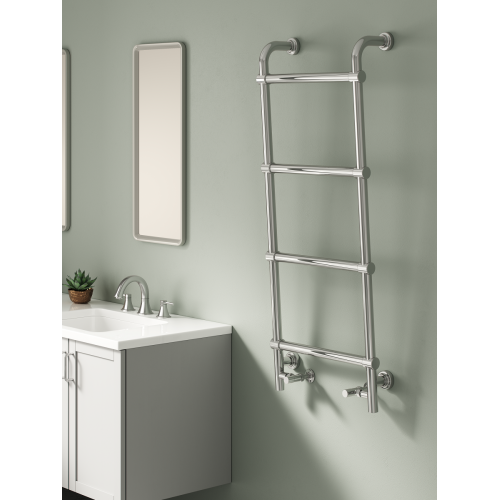
The Eltham is designed primarily as a towel dryer rather than a high-output room heater. Its open ladder design has less surface area than a convector radiator. The BTU output of 689 (at Delta T 50C) is sufficient to warm towels and provide background heat for a small bathroom or en-suite. For larger rooms, you should calculate the heat loss using a BTU calculator and potentially install a secondary heat source.
What are the implications of the 132mm projection depth for installation?
The projection depth of 132mm refers to the distance from the wall to the front of the rail. When roughing in pipework, you must ensure the pipe centers are positioned correctly relative to the wall finish (usually around 70-90mm from the wall depending on bracket adjustment). This depth is significant enough that you must check door swings to prevent the door handle from striking the chrome finish.
Can The Eltham be converted to a dual fuel or electric-only system?
Yes, traditional ladder rails like The Eltham are often compatible with Dual Fuel kits. This involves fitting an electric heating element into one of the vertical legs using a T-piece. You must ensure the element wattage (e.g., 150W) is compatible with the rail's liquid volume to prevent overheating. Always consult a qualified electrician to ensure the installation meets bathroom safety zone regulations.
What type of radiator valves are required for this traditional rail?
The Eltham typically requires standard 1/2" BSP radiator valves. Because it is a traditional rail, Crosshead or Lever style valves in a matching Chrome finish are recommended for aesthetic consistency. If your pipes come from the floor, use Straight valves; if from the wall, use Angled valves. Ensure the valve tails are wrapped with PTFE tape or hemp to prevent leaks at the connection point.
How does the chrome finish affect the heat emission compared to white?
Technically, a Chrome finish has a lower emissivity than a painted (White) surface, meaning it radiates about 20-30% less heat. The chrome plating traps some of the heat inside the metal. While the Eltham looks stunning, if your priority is maximum room heating, you might need to size up slightly compared to a painted model, or ensure your central heating water temperature is optimized.
Is the steel construction susceptible to corrosion in wet bathrooms?
The Eltham is made from mild steel and plated with chrome. While durable, it is not as corrosion-resistant as AISI 304 Stainless Steel. To prevent external rust, you must wipe down the rail regularly to remove condensation. Internally, you must add a central heating inhibitor to the system water to prevent "sludge" and corrosion from attacking the steel from the inside, which is crucial for the 10 Year Guarantee.
What wall fixings are suitable for the weight of this rail?
The Eltham is a heavy unit when filled with water. You cannot rely on standard plasterboard fixings. You must locate the timber studs behind the wall or use heavy-duty toggle bolts or chemical anchors if fixing into masonry. The supplied brackets must be leveled perfectly to ensure the rail hangs straight, preventing stress on the valve connections which could lead to leaks.
Does the 4-section design allow for adequate towel storage?
The "4 sections" likely refers to the horizontal grouping of bars. With a height of 1200mm, the spacing between these bars is generous, allowing for thick bath towels to be easily threaded through. This open spacing also promotes better air circulation around the towels, drying them faster and reducing the risk of damp smells compared to rails with very significantly crowded bars.
What does the 10 Year Guarantee specifically cover?
The 10 Year Guarantee covers manufacturing defects such as leaking welds, material failure, or plating defects (peeling chrome) under normal use. It does not cover damage caused by improper installation, accidental impact, or internal corrosion caused by water quality issues (lack of inhibitor). It effectively guarantees the structural integrity of the rail for a decade.