
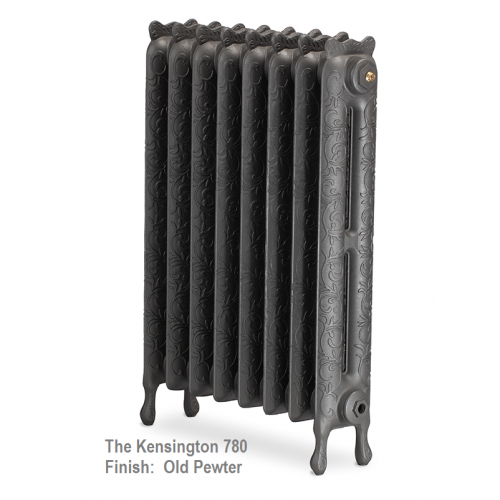
Kensington - 780mm Products
Frequently Asked Questions
My window sill is exactly 800mm from the floor; is the Kensington 780mm model suitable for installation in this space?
Technically no. While the radiator body is 780mm tall, you strictly require a minimum of 50mm (ideally 100mm) of clearance above the radiator to allow the hot air to rise and circulate into the room. Installing a 780mm radiator under an 800mm sill leaves only 20mm of gap, which will trap heat, causing the radiator to overheat locally while failing to warm the rest of the room. You should opt for the 580mm Kensington model in this scenario to ensure efficient convection.
How does the high water content of the 780mm Kensington radiator affect the dosage of corrosion inhibitor required for my central heating system?
The Kensington 780mm is a high-volume unit, holding significantly more water per section than standard steel panel radiators. A single 38-section model can hold over 30-40 liters of water. When dosing your system with inhibitor (like Fernox F1 or Sentinel X100), you cannot simply use one bottle per house. You must calculate the total system volume including these large radiators and likely add 2 or 3 times the standard dose to ensure the concentration is sufficient to prevent rust and hydrogen gas buildup.
Given the 780mm height, is it more difficult to bleed air from this radiator compared to shorter versions?
Yes, taller cast iron radiators like the 780mm model can be prone to stubborn air pockets getting trapped in the top curve of the sections. When filling the system, you must do so slowly to prevent turbulence. If you find the top of the radiator remains cold despite bleeding, you may need to close the lockshield valve completely and force the pump pressure solely through this radiator for a few minutes to push the air pocket toward the bleed valve.
Does the 324 BTU per section output of the 780mm model mean I can use fewer sections than the 580mm model for the same room?
Absolutely. The 780mm model produces roughly 35% more heat per section than the 580mm version (324 BTU vs 240 BTU). This is an excellent problem-solving feature for rooms with limited wall width. For example, if you only have 1 meter of wall space but need high heat, the 780mm model allows you to achieve the required output in a narrower footprint where the 580mm model would simply be too wide to fit.
I am buying the Kensington 780mm radiator in Primer Finish; how do I paint the complex inner sections of such a tall radiator?
Painting a 780mm tall radiator in situ is extremely difficult due to the depth and height of the ornate columns. We strongly recommend using a spray gun or aerosol metal paint rather than a brush to reach the deep inner crevices between sections. If possible, paint the radiator before it is plumbed in and filled with water, as trying to paint the back of a 780mm heavy radiator once installed against a wall is nearly impossible without removing it.
For the larger 38-section Kensington 780mm model, is a standard 15mm copper feed pipe sufficient for the flow rate?
For a radiator of this size (producing over 12,000 BTUs), a standard 15mm pipe is pushing its limit but is usually acceptable if the pipe run is short. However, to ensure the radiator heats up evenly from end to end without balancing issues, it is technically superior to run 22mm pipework as close to the radiator as possible and reduce to 15mm only at the valve tail. This ensures high flow volume reaches the large water gallery of the radiator.
What is the recommended vertical position for the Wall Stay on a 780mm high radiator to strictly prevent toppling?
For the 780mm height, the center of gravity is higher than on standard radiators. You must position the Wall Stay clamping plate between the sections at approximately 650mm to 700mm from the floor (near the top neck of the radiator). Placing the stay too low (e.g., in the middle) acts as a pivot point and may not effectively stop the heavy 200kg unit from tipping forward if a child climbs on it or if it is knocked heavily.