
Grace - Chrome Products
Showing 1 to 2 of 2 (1 Pages)
Frequently Asked Questions
How does the chrome finish of the Grace Towel Rail impact the total heat emission compared to painted models?
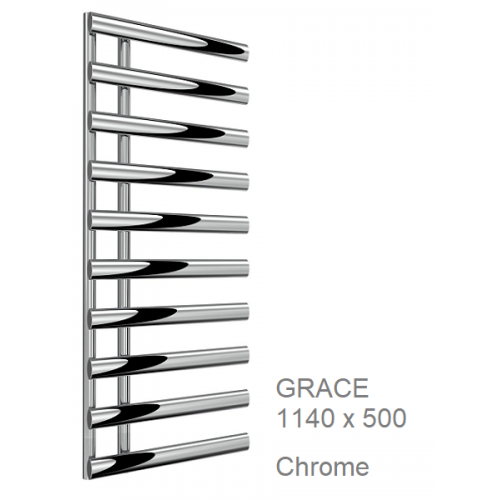
Chrome plating acts as a thermal insulator which technically reduces the radiant heat output of the steel by approximately 20 to 30 percent compared to white or anthracite finishes. For example the Grace Chrome 1140mm model outputs 1104 BTUs. If your bathroom has high heat loss due to large windows or poor insulation you must solve this deficit by either oversizing the radiator (choosing the larger 1140mm over the 780mm) or ensuring you have a secondary heat source like underfloor heating to maintain the ambient room temperature.
What are the precise pipe center measurements for the Grace Chrome 500mm wide model?
For the Grace Chrome 500mm wide rail the pipe centers are not exactly 500mm. The centers are calculated based on the width of the vertical collectors minus or plus the valve variance. Typically for this ladder rail the pipe centers will be approximately 455mm to 460mm depending on your specific valve choice. You must physically measure the radiator with the valves attached before drilling into your floor tiles to avoid the costly problem of misaligned pipes which stresses the valve seals.
What specific electrical components are needed to convert the Grace Chrome to dual fuel?
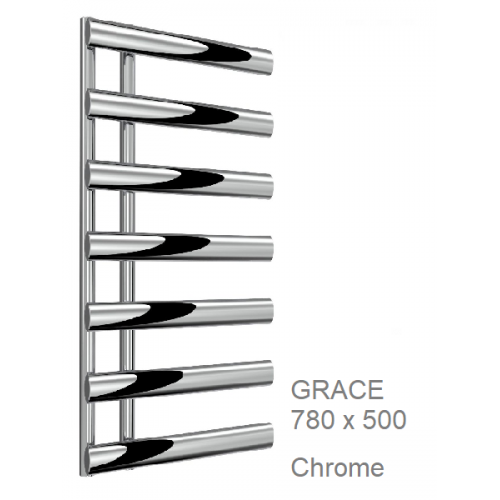
To convert the Grace Chrome to dual fuel for summer use you technically need a T-piece and an electric heating element. The T-piece fits into the inlet allowng both the central heating water and the electric element to enter the rail. You must select an element wattage that matches the rail output to prevent overheating; for the 780mm model (229 Watts) use a 150W element and for the 1140mm model (323 Watts) use a 200W or 300W element. This setup solves the problem of cold towels when the main boiler is off.
How does the 102mm depth of the Grace Chrome affect installation in tight spaces?
The Grace Chrome has a projection of 102mm from the wall to the front face. In narrow cloakrooms or en suites this depth is critical as it may obstruct door swings. To solve this layout problem you must measure the distance from the wall to the nearest door handle or sanitaryware. You should allow at least 150mm of total clearance to ensure that when thick towels are hung on the rail they do not block the walkway or prevent the door from opening fully.
Why might the top bars of the Grace Chrome rail remain cold after installation?
Cold spots at the very top of vertical ladder rails like the Grace Chrome are almost always caused by trapped air pockets that prevent hot water from circulating to the highest point. To fix this technical issue turn off your central heating pump and locate the bleed valve at the top of the vertical upright. Use a radiator key to open the valve slightly until the hissing air stops and water begins to flow. Close it tightly to restore full pressure and even heat distribution across all sections.
What cleaning agents are safe to use on the high gloss chrome finish of the Grace?
Chrome finishes are durable but chemically sensitive. Using abrasive scouring pads or acidic cleaners containing bleach can cause the plating to pit and peel effectively voiding the 10 Year Guarantee. To solve the problem of water marks or limescale buildup you should clean the Grace Chrome only with a soft microfiber cloth and warm soapy water. Regular drying of the surface is essential in humid bathrooms to prevent long term corrosion of the plating.
Is the Grace Chrome compatible with low temperature heat pump systems?
The listed heat outputs (e.g. 1104 BTUs for the 1140mm model) are calculated at Delta T50 which assumes a boiler flow temperature of around 75 degrees Celsius. On a heat pump system operating at Delta T30 the output will drop significantly to around 500 BTUs. To solve this heating shortage you must use the Grace Chrome primarily as a towel warmer rather than a room heater. You will likely need to rely on underfloor heating or a larger fan coil unit to provide the primary heat for the bathroom.
Can the Grace Chrome be installed on a stud partition wall safely?
The Grace Chrome is constructed from robust steel and holds a volume of water that adds significant weight. Installing it on a plasterboard wall using standard rawl plugs runs the risk of the fixings failing. To solve this structural problem you must locate the timber studs behind the plasterboard and anchor the brackets into them. If the stud spacing does not align with the 500mm width of the rail you must install a timber noggin reinforcement behind the wall before tiling to provide a secure fixing point.
How does the section count of the Grace Chrome affect towel drying efficiency?
The Grace Chrome comes in two configurations: the 780mm height has 7 sections and the 1140mm height has 10 sections. From a problem solving perspective if you have a family bathroom you should choose the 1140mm model. The increased number of horizontal bars provides more surface area and better spacing for multiple towels allowing air to circulate between the fabric layers for faster drying and reducing the likelihood of damp odors developing.
What type of valves should I select if my pipes emerge from the wall?
The inlet connections on the Grace Chrome are located at the bottom of the vertical uprights. If your pipework comes out of the wall you should technically use Angled or Corner radiator valves to create the 90 degree turn required to enter the bottom of the rail. Using straight valves in this scenario would force the pipes to protrude into the room creating a tripping hazard and an unsightly finish. Corner valves allow the valve heads to sit neatly inline with the rail for a compact and professional look.