
The Chalfont - Wall Hung Products
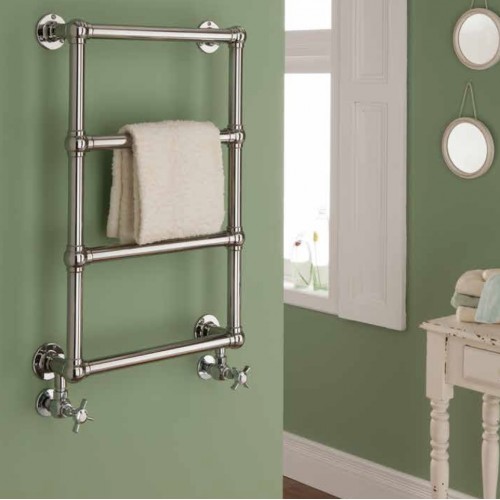
Showing 1 to 1 of 1 (1 Pages)
Frequently Asked Questions
Why is the heat output (577 BTUs) lower than other traditional column rails?
The Chalfont Wall Hung is designed primarily as a towel warmer rather than a primary room heater. Its compact design features fewer column sections and a smaller overall water volume compared to large floor-standing models like the Boleyn. The 577 BTU output is sufficient to dry towels and take the chill off a small en-suite, but for larger bathrooms, you will technically need an additional radiator or underfloor heating.
What are the structural wall requirements for installing this wall-hung traditional rail?
Because the Chalfont hangs fully on the wall without floor support, the fixing points bear significant load. You must install this rail onto solid masonry walls or timber studwork reinforced with noggins. Installing directly into plasterboard using only toggle bolts is technically unsafe, as the leverage from the 125mm projection and the weight of wet towels could pull the fixings loose over time.
How does the choice of finish (e.g., Antique Bronze vs Chrome) affect the heat emission?
Technically, the surface finish has a measurable but minor effect on heat emission. Chrome plating has a low emissivity value (it radiates less heat) compared to painted or darker metallic finishes like Antique Bronze. Therefore, the Antique Bronze or Nickel versions may offer slightly better radiant heat performance than the highly reflective Chrome model, though the difference is usually less than 5% in domestic applications.
What valve orientation is required for this wall-mounted model?
The Chalfont Wall Hung features bottom connections. Since the unit is wall-mounted, your pipework will likely emerge from the wall rather than the floor to keep the look "floating" and clean. Therefore, you will typically require Angled Valves or Corner Valves to connect the horizontal wall pipes to the vertical inlets of the rail. Using straight valves would require pipes to run up the wall from the floor, which can look untidy.
Is the Chalfont compatible with electric-only conversion?
Yes, the Chalfont can technically be converted to electric-only or dual fuel, provided the element fits the vertical leg. However, due to its small liquid capacity and specific traditional design, you must carefully select a low-wattage element (e.g., 100W or 150W) that does not boil the water inside the compact frame. You must also ensure the element cable entry can be neatly managed without ruining the vintage aesthetic.
Does the 125mm wall projection include the valves?
The 125mm depth refers to the distance from the wall to the front face of the towel rail itself. It does not include the width of the radiator valves. Traditional manual crosshead valves can protrude further than the rail or sit within the footprint depending on the pipe centers. You must allow a total clearance zone of approximately 150-180mm to ensure you don't install it behind a door that opens inwards.
What is the advantage of the 'Bright Nickel' finish over standard Chrome?
Bright Nickel offers a warmer, slightly golden hue compared to the cold, blue-ish tint of Chrome. Technically, nickel plating is often used as the undercoat for chrome, so a nickel finish is simply the process stopped one step earlier (and sealed). It is excellent for matching traditional tapware from brands like Lefroy Brooks or Perrin & Rowe, where "Nickel" is a standard period finish that develops a rich patina over time if unlacquered (check if TRC's is lacquered).
How do I bleed air from this specific wall-hung configuration?
Like most ladder rails, air will accumulate at the highest point. The Chalfont will have two vertical collectors. One will be capped, and the other will house a bleed screw (air vent) hidden at the top. You must use a bleed key to open this vent when the rail feels cold at the top. Because the volume is small, the air will clear quickly, so have a cloth ready immediately to catch the water spray.
Can this rail be installed on a secondary hot water loop (DHW)?
Generally, no. Most steel towel rails like the Chalfont are designed for closed-circuit central heating systems only. Connecting mild steel products to a secondary domestic hot water loop (fresh water that comes out of your taps) will cause rapid corrosion and rust because the water is constantly oxygenated. You would need a specific DZR brass or stainless steel model for DHW circuits.
What does the 10 year guarantee cover regarding the plating and brazing?
The 10 year guarantee covers the water-tightness of the brazed joints (where the tubes meet) and the integrity of the plating. It ensures that the chrome, nickel, or bronze finish will not peel, bubble, or flake under normal bathroom humidity. However, it technically excludes damage caused by aggressive cleaners (acids/bleach) or internal corrosion caused by a lack of inhibitor in the heating system.